Hair Growth Products: Which Ingredients Actually Have Evidence? (Rosemary, Caffeine, Biotin, DHT Blockers)
Short answer: for the ingredients most often sold as hair growth actives, we found no independent, placebo-controlled human trial showing that a cosmetic regrows hair on the scalp. Rosemary oil rests on one small trial with no placebo. Caffeine's clearest results come from follicles in a dish; the one shampoo trial we found tested a caffeine and adenosine blend with no confirmed placebo. Biotin hasn't been tested on the scalp in any study we checked, and we found no study measuring scalp DHT after rosemary, saw palmetto, pumpkin seed or green tea, the usual "DHT blockers". That isn't proof these ingredients do nothing, just that the evidence isn't there. In our view an ingredient list alone won't settle it either, because it isn't required to show how much of anything is in there.
This guide goes ingredient by ingredient, says who funded the research where it matters, and stops at the line between cosmetics and medicines. It is not medical advice. For causes and types of hair loss, see our guide to understanding and managing hair loss. If your hair is naturally fine rather than thinning, start with how to thicken hair naturally. We cover fine hair in more detail in how to thicken thin hair.
What should I look for in the ingredient list of a hair growth product?
| Ingredient | Best human evidence we found | Verdict |
|---|---|---|
| Rosemary oil | One trial of 100 patients against minoxidil 2%, no placebo, full text not reached | Not established |
| Caffeine | Follicles in a dish; one 77-person trial of a caffeine + adenosine shampoo, design unconfirmed | Not established for caffeine alone |
| Biotin (in shampoo) | No study of biotin applied to scalp or hair | No evidence either way |
| Saw palmetto (on the scalp) | One trial with maker-affiliated authors: no significant change in blood DHT against placebo | Not established |
| Green tea (EGCG) | Lab enzyme tests only | No human trial found |
| Redensyl, Capixyl, Procapil | No independent placebo-controlled scalp trial of any one on its own | Not established |
| Pumpkin seed, onion, castor and other oils | Candidate trials not verified, or whether one exists not established; the onion trial was in a different condition | Not established |
| Minoxidil | A licensed medicine, not a cosmetic ingredient | A question for a pharmacist, GP or dermatologist |
Why we keep saying "placebo": without a comparison group on a dummy treatment, a rise in hair counts can't be separated from seasonal changes or measurement effects, and when two products both show a rise, that can't show either one worked.
The list itself tells you little. Ingredients above 1% are listed in descending order of weight; below 1% they can appear in any order, and the list isn't required to show percentages. So an active's position can't tell you whether there is enough of it to do anything. The cosmetic claims rules say a claim that carries an ingredient's properties over to the product needs evidence, such as showing the ingredient is present at an effective concentration, so that is a fair question to ask the brand. In our view, an ingredient list alone can't show whether a product works, or whether it is legally a medicine.
Under UK law a product is a medicine if it is presented as preventing or treating disease, or if it can be used to restore, correct or change a body function through a pharmacological, immunological or metabolic action. The MHRA classifies finished products, not single ingredients, weighing the claims, the packaging and whether the ingredients act on the body at the dose present. Advertising rules require evidence, including trials on people where relevant, for claims to slow hair loss or stimulate growth. In 2018 the ASA upheld a complaint against a caffeine shampoo ad claiming it could help reduce hair loss, because the evidence wasn't adequate. What it hadn't seen was a well-designed trial of the actual product, used as customers use it, with an objective measure of hair growth. That judged the evidence, not the shampoo.
Minoxidil, for example, is banned as a cosmetic ingredient in Great Britain and the EU. In the UK, 5% minoxidil scalp products are licensed General Sales List medicines, with separate licences for men and for women. Whether to use any medicine is a question for a pharmacist, GP or dermatologist.
How much shedding is normal? We found no measurement behind the familiar "50–100 hairs a day". In one Beijing clinic, healthy adults lost about 28 hairs per wash on average, against about 125 in people with telogen effluvium (a condition of increased shedding); these are group averages, not cut-offs. Shedding is also seasonal: in 14 Sheffield men it peaked in August and September at more than double the winter rate.
See a GP if you are worried about your hair loss, or if you have sudden hair loss, bald patches, hair coming out in clumps, a scalp that itches or burns, or a red or swollen scalp. Suspected scarring hair loss should be referred promptly because it is irreversible.
How to block DHT for hair loss: what has been measured
DHT (dihydrotestosterone) is made from testosterone by an enzyme, 5α-reductase. Our November 2026 searches found no human study that measured scalp DHT after rosemary, saw palmetto, pumpkin seed oil or green tea was put on the scalp. The nearest is a 16-week, placebo-controlled trial of a 20% saw palmetto lotion (73 of 80 adults finished), in which four of the six authors work for the extract's maker. The lotion made no significant difference to blood DHT against placebo, the paper doesn't say how DHT was measured, and scalp DHT wasn't measured.
The "DHT blocker" idea comes mostly from the lab. Green tea's EGCG blocked the enzyme in cell-free tests but not in whole cells. A rosemary leaf extract blocked it by 82–95% in a test tube and improved regrowth in testosterone-treated mice. That is a leaf extract, not the oil, in mice, not people.
Our reading of the law: a product that genuinely lowered DHT through a pharmacological action would sit on the medicine side of the line. Finasteride, for example, is a prescription-only medicine. In short, we found no evidence that rosemary, saw palmetto, pumpkin seed oil or green tea lowers scalp DHT in people, and medicines are a matter for your GP.
See a GP if you are worried about your hair loss, or if you have sudden hair loss, bald patches, hair coming out in clumps, a scalp that itches or burns, or a red or swollen scalp. Suspected scarring hair loss should be referred promptly because it is irreversible.
Does rosemary oil work for hair growth?
The case rests on one 2015 trial whose full text we couldn't reach; the abstract (summary) leaves out dropouts, the oil used and how it was applied. 100 patients with pattern hair loss (PubMed's index tags them as men, but the abstract doesn't state sex) used rosemary oil or minoxidil 2% (the UK minoxidil licences mentioned above are for 5%) for six months. Neither group changed significantly at three months; both had higher hair counts by six months, and the two groups didn't differ significantly.
That isn't "as good as minoxidil". With no placebo group, the rise within each group can't be separated from season or measurement effects, and "no significant difference" with about 50 people per group doesn't show the two are equal. A 2026 systematic review whose six authors all worked for one company (Mediprobe Research) found this was still the only rosemary oil trial meeting its rules, and registry searches found no other trial of rosemary oil alone.
In 2024 the EMA's herbal medicines committee did not accept well-established use for rosemary oil or leaf, citing a lack of data to show efficacy and the EU rule requiring ten years' medicinal use. It set the hair-loss trial aside because rosemary lacked ten years' EU use for that purpose, without judging the trial itself. Its report lists contact dermatitis as a possible reaction at unknown frequency, so it can't say how common it is, and notes there are no safety data from clinical trials. In the 2015 trial, scalp itching rose in both groups, more with minoxidil.
We found no peer-reviewed, regulatory or trial source for the claim that rosemary makes hair fall out at first. Minoxidil's UK label does warn of temporary extra shedding two to six weeks after starting, but no source we found carries that over to rosemary.
Scalp irritation is a reason to ask a pharmacist, GP or dermatologist. See a GP if you are worried about your hair loss, or if you have sudden hair loss, bald patches, hair coming out in clumps, a scalp that itches or burns, or a red or swollen scalp. Suspected scarring hair loss should be referred promptly because it is irreversible.
Caffeine shampoo, biotin and other "growth" actives
Does caffeine shampoo work?
In two lab studies, follicles taken from the scalp were grown in a dish for five to eight days. Testosterone held back their growth, and caffeine counteracted that. But they used testosterone, not DHT, and the follicles sat in caffeine (0.0005–0.005%) for days, with no skin in the way and no rinsing.
One study found caffeine from a shampoo left on for two minutes did get in, fastest through the follicles (the abstract doesn't say which body site). But it measured caffeine reaching the blood, not how much reached the part of the follicle that grows hair. No study we found shows a rinse-off wash delivers the levels that worked in the dish.
The one shampoo trial we found tested caffeine plus adenosine in 77 people for three months and reported a significant rise in hair density. One author works for a commercial company, the abstract doesn't say whether there was a placebo or blinding, and caffeine's share can't be separated from adenosine's. Plausible in the lab; not established in a shampoo.
Biotin
Biotin's reputation comes from supplements, and even there a review found it "has no proven efficacy in hair and nail growth of healthy individuals". Another review, focused on older adults, says deficiency is "very rare in healthy patients who eat a balanced diet". We found no study of biotin applied to the scalp or hair; the only topical sources were manufacturers' patents about skin and nails. That is an evidence gap, not proof it doesn't work.
Redensyl, Capixyl and Procapil
We found no independent, placebo-controlled scalp trial of any of these on its own. The closest, a university trial with no funding, tested a four-ingredient tonic (including acetyl tetrapeptide-3 and red clover extract) on 32 people for 24 weeks against 3% hospital-made minoxidil (not the 5% strength of the UK licences mentioned above), with no placebo. Terminal hair counts rose about 8% from the start in both groups. That isn't proof they're equal, and no single ingredient can be credited.
Oils and home remedies
Pumpkin seed oil and onion juice each have a candidate trial we couldn't verify, and the onion trial was in alopecia areata (patchy hair loss), not ordinary thinning. For amla, black seed, castor oil and turmeric, we couldn't establish whether any controlled human trial exists.
See a GP if you are worried about your hair loss, or if you have sudden hair loss, bald patches, hair coming out in clumps, a scalp that itches or burns, or a red or swollen scalp. Suspected scarring hair loss should be referred promptly because it is irreversible.
Questions people ask
What is the best ingredient for hair growth?
Of the cosmetic ingredients covered here, we found none with an independent, placebo-controlled human trial showing it regrows hair on the scalp. Minoxidil is a licensed medicine, a question for a pharmacist, GP or dermatologist.
Does rosemary oil really work as well as minoxidil?
That claim comes from one trial with no placebo group, where both groups improved and didn't differ significantly. That can't show either worked.
Can a shampoo block DHT?
We found no human study measuring scalp DHT after rosemary, saw palmetto, pumpkin seed oil or green tea. In the one trial that measured blood DHT after a saw palmetto lotion, it didn't change against placebo.
See a GP if you are worried about your hair loss, or if you have sudden hair loss, bald patches, hair coming out in clumps, a scalp that itches or burns, or a red or swollen scalp. Suspected scarring hair loss should be referred promptly because it is irreversible.
Scalp care we stock
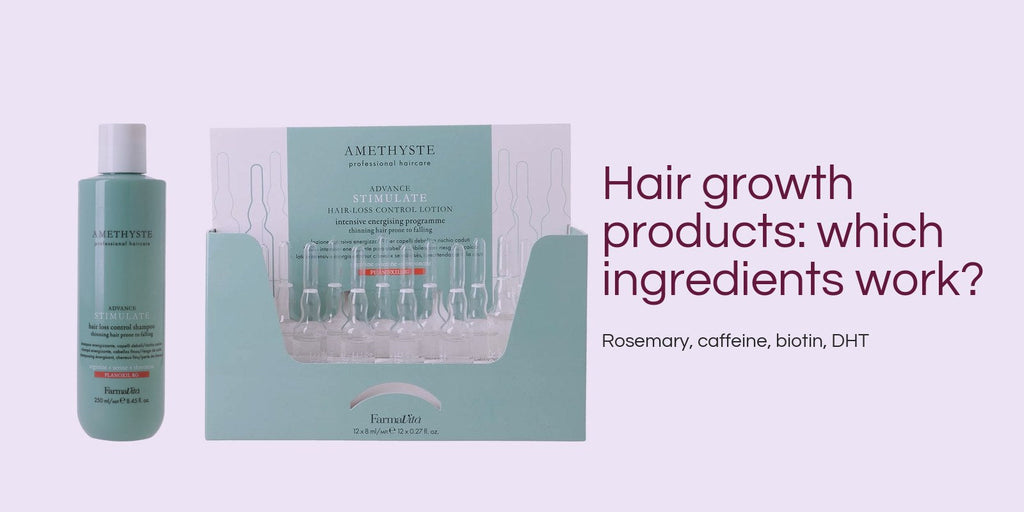
We sell the FarmaVita Amethyste Advance Stimulate range; the names are the manufacturer's. We haven't seen a trial of these products, and nothing here is evidence that they, or any cosmetic, stop or reverse hair loss.
- FarmaVita Amethyste Advance Stimulate Hair Loss Control Shampoo 250ml
- FarmaVita Amethyste Advance Stimulate Hair Loss Control Shampoo 1000ml
- FarmaVita Amethyste Advance Stimulate Hair Loss Control Lotion 12x8ml
See the full FarmaVita Amethyste range, or read more on common hair care ingredients.
Sources: UK Human Medicines Regulations 2012, reg 2(1); MHRA Guidance Note 8 (borderline products); CAP Code rule 12.23; ASA ruling A17-387365, 28 March 2018; GB and EU cosmetics Regulation 1223/2009, Annex II entry 372 and Article 19; emc SmPCs for UK 5% minoxidil products (PL 15513/0365, PL 15513/0135); emc listing for finasteride 1 mg. Hiipakka et al. 2002, PubMed 11931850. Sudeep et al. 2023 (maker-affiliated authors), Clin Cosmet Investig Dermatol 16:3251. Murata et al. 2013, PubMed 22517595. Panahi et al. 2015, PubMed 25842469. Gupta et al. 2026 (Mediprobe Research), Medicina 62:1282. EMA/HMPC assessment report on rosemary oil and leaf, Rev 1, 2024. Fischer et al. 2007, PubMed 17214716; Fischer et al. 2014, PubMed 24836650. Otberg et al. 2007, PubMed 17396054. Chen et al. 2024 (one commercially affiliated author), PubMed 38764299. Patel, Swink & Castelo-Soccio 2017, Skin Appendage Disord. Shing, Aragon Sierra & Shah 2025, Int J Women's Dermatol. Manufacturer patents US 4,584,191 and 5,166,168 (skin and nails). Lueangarun & Panchaprateep 2020, PubMed 33584955. Li et al. 2022 (Peking University People's Hospital), daily wash counts. Randall & Ebling 1991, PubMed 2003996. Cosmetic claims criteria, Regulation 655/2013 (GB-retained). GP guidance: NHS and nidirect hair-loss pages; BNSSG dermatology pathway.