Ceramic vs Titanium vs Tourmaline Straighteners: What the Plate Terms Actually Mean
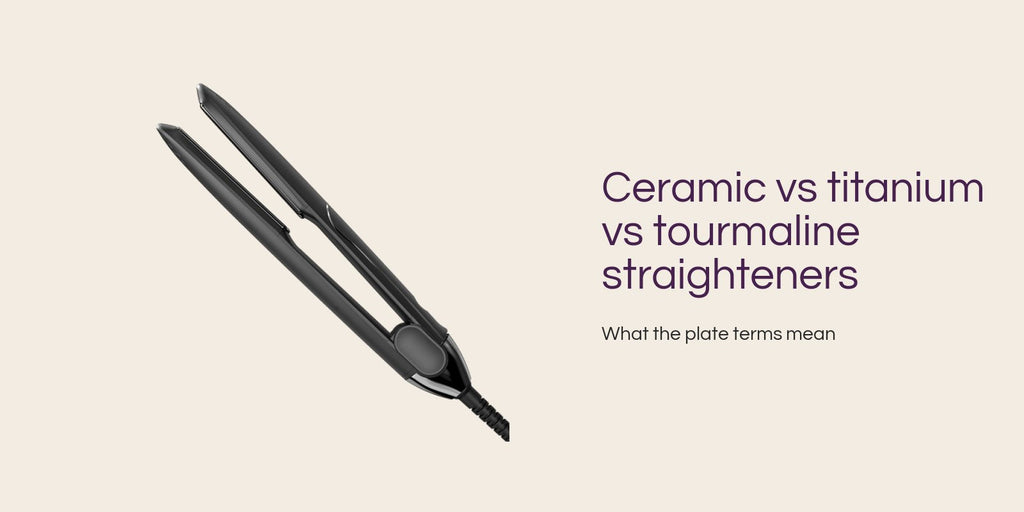
Ceramic, titanium, tourmaline, ionic, far-infrared and floating plates are terms for a straightener's plate materials, mounting or built-in features. None of them is a measured result on hair. When we searched the published research, we found one small study comparing a ceramic iron with another plate type on hair, one hair study of an ionic hair dryer (not a straightener), and none at all for titanium, tourmaline, far-infrared or floating plates. So we found no evidence either way on whether ceramic or titanium plates are better for hair. What has been measured is how hot straighteners get and what repeated heat does to hair.
We sort each term into three kinds of claim: materials physics (true of the material, but not shown on hair), manufacturers' claims (from patents and product descriptions), and what has actually been tested on hair. For technique, see our guide to mastering the hair straightener.
The short version
- Ceramic: a broad materials word; we found no hair-tool definition. One small, industry-linked study on one person's hair. We found no study comparing coated and solid ceramic plates.
- Titanium: often a titanium coating on an aluminium plate. No hair measurement found.
- Tourmaline: a mineral whose crystals build up surface charge when their temperature changes. Nothing we found links that to any measured effect on hair.
- Ionic: we found no standard definition, just a safety rule for tools fitted with an ion generator and a method for measuring a dryer's ion output. The only hair study we found was on a hair dryer, and it did not measure frizz.
- Far-infrared: in patents, a band of infrared (about 6 to 14 micrometres) that water absorbs strongly. We found no study showing any effect of a far-infrared emitter on hair.
- Floating plates: plates mounted so they can tilt, described in patents as lining up with the hair. No standard definition and no hair measurement found.
Ceramic straighteners: what "ceramic" means
We found no hair-appliance standard or trade definition of a "ceramic" plate. The word is a general materials term that covers many different materials. A straightener sold as "ceramic" does not tell you which ceramic, or how much of it, and nothing in our sources links that choice to what happens on hair.
There are also two different constructions. Patents describe both a solid ceramic plate and a metal plate with a ceramic coating. No source we found measures or compares the two on hair, so any claim that solid ceramic is better than coated (or the reverse) is untested.
In a bench test by hospital clinicians of eight household straighteners (published in 2008; tested before May 2007), seven had ceramic plates.
The only hair measurement we found is a 2024 Korean study, run as a joint project with an appliance maker, on hair from a single 19-year-old donor. It compared one ceramic iron (type and composition not given) with one iron with a PTFE (non-stick) surface, on bleached, dyed hair, as part of a chemical heat-perm treatment. The ceramic iron tended to cause more moisture loss and more colour fade. But there were no statistics, so the study cannot show the difference was bigger than chance; there was one operator, and friction and plate pressure were not measured or controlled. The result applies to those two irons, not to ceramic as a class.
Titanium straighteners
We found no definition of a "titanium" hair-tool plate either. Plates sold as titanium are often titanium-coated aluminium.
The one titanium-plate patent our research opened (US 7,445,012, a titanium-coated aluminium plate) justifies titanium by sterilisation and by stopping hair catching, not by heat transfer. We found no measurement of titanium plates on hair, so we also found no study of ceramic vs titanium straighteners on hair.
Tourmaline straighteners
Tourmaline is a mineral, and the physics here is real. Its crystals are pyroelectric: their surface builds up an electric charge when their temperature changes. In a study of solid single tourmaline crystals, the effect was weaker the more iron the crystal contained. The same paper notes that the charge only arises while the temperature is changing and dissipates in air: on those crystals, it appears while heating up or cooling down, not while held at a steady temperature.
The hair-tool patent in our research uses tourmaline powder in a coating, not solid crystals: it describes a curling-iron coating containing tourmaline powder and claims it gives off "negative ions". Nothing in our sources measures that on a plate, and nothing in them links tourmaline to any measured effect on hair.
Ionic straighteners
We found no standard definition of "ionic" or "negative-ion". A 2008 amendment to the international safety standard for hair appliances says that, if an ion generator is fitted, the air-cleaner safety rules also apply, as far as is reasonable. A separate standard for measuring hair-appliance performance added, in 2022, a method for measuring how many negative ions an "anion" hair dryer gives off. Neither, in the parts our research could read, defines what an ionic tool must achieve.
The only hair study we found was on a hair dryer, not a straightener. In a 2021 Korean study co-authored by the maker's engineer, hair bundles lost static faster after the maker's "plasma" dryer than after its conventional dryer. That dryer gave off both kinds of ion, mostly positive ones. Airflow was not matched, there was no test with the ion generator switched off, there were two trials and no statistics. Frizz was not measured. More on dryers in what to look for in a salon hair dryer.
Far-infrared
Patents define far-infrared, for these products, as light of roughly 6 to 14 micrometres wavelength (one says 5 to 15). Water absorbs this range strongly. Using published optical data for liquid water, it penetrates only about 16 to 19 micrometres at the most transparent part of this range (8 to 10 micrometres) before about two-thirds of it is absorbed, and only about 3 to 5 micrometres at around 6, 12 and 14 micrometres. That is the physics of a beaker of water, not of hair. No source we found shows any effect of a far-infrared emitter on hair.
Floating plates
Floating plates are plates mounted on springs or a pivot so they can tilt. That description comes from patents: one recent example describes plates that adjust freely about a pivot, with a spring returning them to a neutral position, and describes the plate as lining up with the hair surface. We found no standard definition and no peer-reviewed measurement of floating plates on hair. Whether they change pressure, snagging or results on hair has not been tested in anything we found.
What has actually been measured: heat and time
In that bench test, the eight household straighteners reached an average maximum plate temperature of 163 °C, ranging from 122 to 210 °C. The setting used was not stated. They took 18 to 44 minutes (26 on average) to cool to 40 °C after switching off. We found no peer-reviewed study comparing the temperature on a straightener's display with the measured plate temperature. In one supplier's study (three untreated tresses), hair-surface readings taken after ironing sat 44 to 56 °C below the iron's 232 °C setting. How big that gap is depends on how it is measured, so treat it as one study's result, not a rule.
On repeated heat, lab studies with industry links found damage on hair samples built up with total contact time with the iron. One BASF study on virgin hair (never coloured or chemically treated) found tiny pores inside the hair from about 150 °C set temperature, increasing with heat and with the number of ironing cycles, which the author put down to water in the hair turning to steam. With slow passes, larger holes formed at about 210 °C, and at about 220 °C and above bubbles formed and the fibres turned brittle. In curling-iron tests, wet hair showed more structural damage than drier hair, though results are mixed: the same paper rates short repeated wet cycles comparable to dry. Our reading, not a tested rule: avoid slow, repeated passes at the top settings.
On real heads, one clinic study found more microscopic changes along the hair shaft in women who reported heat styling or perming, but no difference in a measure of breakage, and it recorded no temperatures.
Bleached hair responds differently. In one lab series a lab marker of the hair's protein structure (its wet denaturation temperature) measured about 140 °C before any ironing, against about 155 °C for natural hair. That is a lab marker, not a safe limit. In the same lab's work, 800 seconds of total contact (about 480 passes of 1.67 seconds) with an iron set to 200 °C cut the wet stiffness of natural hair by 16% and of twice-bleached hair by 37%. See how to care for bleached hair.
No source in our research establishes a single safe straightening temperature. The figures depend on moisture, method, the hair's history and the number of passes. For the everyday habits around heat, see the do's and don'ts of heat tools, and for products, our blow-dry and heat protection range.
So what should you look for?
Our reading of the evidence, not a tested result: treat plate names as descriptions of materials, not proof of what happens to hair. Because the measured effects track heat and contact time, a temperature control you can actually turn down, and a technique that avoids going over the same section again and again, are worth more attention than the plate label.
Our listing for the WAHL Pro Glide Straightener describes ceramic-coated, keratin-infused plates and a digital setting from 150 to 210 °C. That is a product description; we have not tested it. You can see what we stock in professional hair straighteners.
Questions people ask
Is ceramic or titanium better for hair straighteners?
We found no measurement that answers it. We found no study of titanium plates on hair, so we found none comparing the two. The one ceramic study compared a single ceramic iron with a non-stick iron on one person's hair, with no statistics.
Do tourmaline straighteners work?
Tourmaline crystals do build up surface charge when their temperature changes. We found nothing showing that tourmaline in a straightener's plates has any measured effect on hair.
What are floating plates on a straightener?
Plates mounted on springs or a pivot so they can tilt; patents describe them as lining up with the hair. We found no standard definition and no measurement of their effect on hair.
Do ionic straighteners reduce frizz?
We found no hair study of an ionic straightener. The one hair study of an ionic dryer found faster loss of static, but frizz was not measured and there was no test with the ion generator off.
Products mentioned
Sources: Breuning & Papini 2008, Burns, plate temperatures of eight straighteners, PubMed 18036743 (abstract). Hyun 2024, J Korean Soc Cosmetol 30(5):1027, ceramic vs PTFE iron (industry–academia project with Unix Electronics), doi:10.52660/JKSC.2024.30.5.1027. Hyun & Hwang 2021, J Korean Soc Cosmetol 27(4):940, ionic dryer and static (Unix co-author), doi:10.52660/jksc.2021.27.4.940. Hawkins, MacKinnon & Schneeberger 1995, Am Mineral 80:491–501, tourmaline pyroelectricity. Hale & Querry 1973, Appl Opt 12(3):555, optical constants of water, doi:10.1364/ao.12.000555. Wortmann, Wortmann & Popescu 2020, J Therm Anal Calorim 140:2171, doi:10.1007/s10973-019-08252-2. Wortmann, Quadflieg & Wortmann 2022, Int J Cosmet Sci, PubMed 35689553. Gamez-Garcia 2011 (BASF), J Cosmet Sci, PubMed 21635840. Zhou 2011, J Cosmet Sci, PubMed 21635854. Ruetsch & Kamath 2004, J Cosmet Sci 55:13–27, PubMed 15037918. Malkani 2020, Indian Dermatol Online J 11(4):551, PubMed 32832441. IEC 60335-2-23 AMD1:2008 and IEC 61855:2022. Patents US 7,445,012 (titanium-coated plate), US 5,941,253 (tourmaline coating), US 6,378,225 (far-infrared radiator), US 12,035,792 (floating plates), US 7,800,020 and US 8,080,764 (solid and coated ceramic plates). All as summarised in our hair-chemistry research notes.