
How Do Perms Work? Are Perms Permanent?
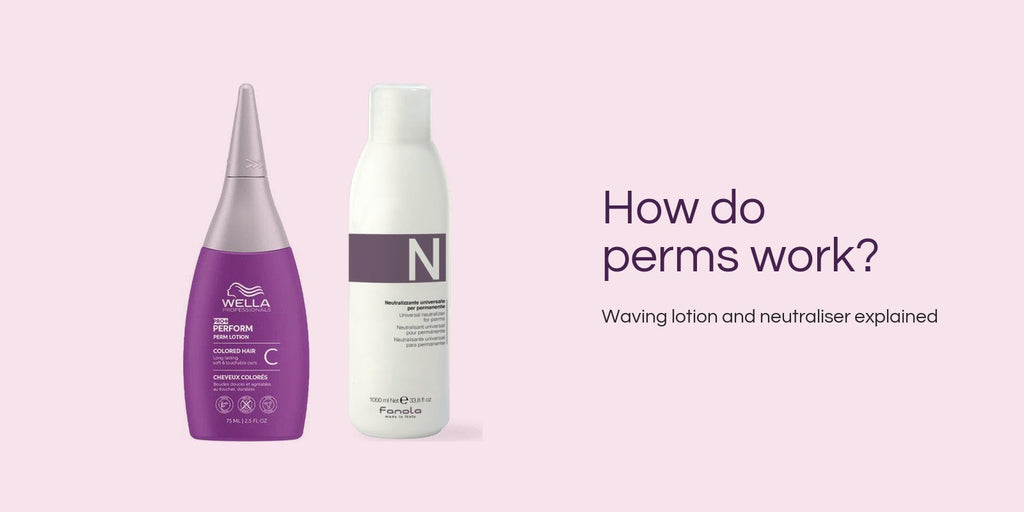
A perm (short for "permanent wave") works in two steps. A lotion breaks some of the disulfide bonds that hold hair's shape while it is wound on rods; a neutraliser then re-forms them in the new shape, though not completely. In lab tests, permed hair relaxed only slowly in water; regrowth is unpermed, and salons commonly re-perm roughly every 6–8 weeks, though it varies by client.
The perm lotions and neutralisers we sell are professional products: GB law requires professional thioglycolate perm lotions to be labelled "For professional use only", and lets them be stronger: up to 11% (as thioglycolic acid), against 8% for products sold for general use. The timings below are what manufacturers tell stylists, not home instructions. Our advice: if you want a perm, have it done by a trained stylist.
Perms at a glance
| Question | Short answer | Who says so |
|---|---|---|
| Is it permanent? | Permed hair relaxed only slowly in water in lab tests; regrowth is unpermed | Wortmann et al. 2021 (lab study) |
| How long does it last? | Schwarzkopf: 12 weeks (Classic, Glamour Wave); consumer blogs: 3–6 months; salons commonly re-perm about every 6–8 weeks, varying by client | Manufacturers; salon guide. No test method |
| How long is the lotion left on? | Roughly 5–25 minutes, by product, hair and heat | Wella, Schwarzkopf, FarmaVita |
| Can you wash it straight away? | No agreed rule; follow your stylist or the product | Sources disagree |
What is a perm? (perm meaning)
"Perm" means permanent wave: a long-lasting wave set by mechanical means (winding hair on rods) and chemical means (a lotion, then a neutraliser). As a verb, to perm hair is to give it a permanent wave. Merriam-Webster, Collins and Cambridge give the equivalence; Evans (2021), reviewing perm chemistry, calls the word "a truncation of the term permanent wave".
How does a perm work?
A perm reshapes hair in two chemical steps: a lotion breaks some of the bonds that hold its shape while it is wound on rods, then a neutraliser re-forms them in the new shape, though not completely (see Step 3).
The target is the cystine disulfide bonds, sulfur crosslinks inside the hair. A perm breaks some of them while the hair is held in a new shape, then re-forms them so the shape stays. Wella puts it simply: the bonds "are opened by perm lotion … and fixed into new position with neutralizer".
That is what separates a perm from a blow-dry or a wet set. Hair dried while held in shape keeps a "cohesive set" of weaker hydrogen bonds, which water undoes (Feughelman 1982); a perm set works through the stronger covalent disulfide bonds (Wortmann and Souren 1987).
Step 1: wash and wind
Wella specifies INVIGO Aqua Pure shampoo, then towel-drying. Schwarzkopf says to cleanse "without massaging the scalp" and adds a pre-treatment on the lengths and ends that is not rinsed out. The hair is wound on rods; salons judge a perm by whether the finished curl matches the rod size ("true to rod"), according to a Journal of Cosmetic Science review. Schwarzkopf protects the hairline with damp cotton wool while the lotion goes on.
Step 2: the lotion breaks some bonds
The lotion is a reducing agent that breaks some of the disulfide bonds while the hair is held on the rods. In one 1977 Redken study using in-house lotions, salon samples had 17–43% of their cystine reduced, so in that study under half of these bonds were broken. Heat speeds this up in the manufacturers' tables (Schwarzkopf Classic on normal hair: 10 minutes under a cap at 45 °C, against 15–20 without), but Schwarzkopf's table rules out heat for tinted or porous hair and for hair more than 30% highlighted. Schwarzkopf gives no reason, though separately Evans (TRI-Princeton, an industry-funded institute) reports that bleached hair is reduced "considerably faster" than virgin hair, a single-source finding.
The end point is judged with test curls. Wella: "Determine the final development time by taking test curls at different areas of the head. Open a rod gently to see if the hair is curled." Schwarzkopf looks for an "S" shape bend and says: "Do not exceed the maximum processing time." FarmaVita says to check every 3–5 minutes. Test curls pick the moment inside the manufacturer's window, never beyond it, so stylists start checking at the low end of the stated time. Why the ceiling: in one industry lab test, dry hair broke at about 45% lower force than untreated hair after 60 minutes' processing, against about 28% after 15 (see the damage section), and no verified method reverses a perm. Stopping too early is the opposite risk: Evans proposes that slow-reacting "resistant" hair can end up with too few bonds broken, so the curl drops early.
Step 3: rinse, then neutralise
The lotion is rinsed out with the rods in: 3 minutes in Wella's directions, then blot with a towel; 5 minutes in Schwarzkopf's. The only reason we found for a thorough rinse is Wortmann and colleagues' explanation, untested, that poor rinsing between the steps is one cause of occasional weak or unstable waves. The neutraliser is an oxidant that re-forms the bonds in their new position; Schwarzkopf's and Fanola's ingredient lists show hydrogen peroxide. Wella and Schwarzkopf (Hydrowave Classic and Glamour Wave) both put two-thirds of the neutraliser on the rods for 5 minutes, remove the rods (Schwarzkopf: "without pulling the hair"), then apply the last third for 5 minutes more, about 10 minutes in all (FarmaVita: 5, then 3–5 more after unrolling). FarmaVita says "Do not comb."
Re-forming is not complete. A Journal of Cosmetic Science review says it is "generally not possible to completely rebuild all disulfide bonds", leaving hair "somewhat depleted in cystine content" and "in a compromised state" (for how much, see the damage section). Air can re-form bonds, but in the Redken study air oxidation of unneutralised hair was "not complete even after 24 h" (an indirect measure), and the review calls a neutralising agent "prudent". In practice, a stylist gives the neutraliser its full time rather than relying on air.
Are perms permanent?
Not entirely. In lab tests the permed lengths relaxed only slowly in water, though the ends can soften with weathering; new growth comes in unpermed, so the roots need redoing, and salons commonly re-perm roughly every 6–8 weeks, though it varies by client.
What happens to the permed lengths
In a 2021 lab study by Wortmann and colleagues, single hairs permed on a 12 mm rod and held in water at 35–95 °C only partly relaxed within 8-hour experiments; the most they recovered was about 55–60%, and only at 85–95 °C. The authors conclude the wave "will … be perceived as permanent", though their own model assumes it would eventually relax fully. Those top temperatures are far hotter than any wash. Shampoo, brushing and heat styling were not tested, so none of this says how long a perm lasts on a head.
Why perms grow out
Scalp hair grows roughly 0.8–1.3 cm a month (our conversion of group averages from a L'Oréal-funded study), so 6–8 weeks brings about 1.1–2.4 cm of unpermed regrowth. Wortmann and colleagues put re-perming at about 6–8 weeks down mainly to regrowth, and curl loss towards the ends to weathering (UV, humidity, heat) and to bleaching or dyeing; that is their interpretation, not tested. Schwarzkopf allows a root application of its Hydrowave Creative gel 6–8 weeks after an initial perm, on no more than 5 cm of regrowth. That 5 cm is a ceiling, not a typical figure, and Schwarzkopf gives no reason for it; at the growth rates above, 6–8 weeks of regrowth is well inside it.
How long does a perm last?
We found no independent study measuring how long a perm holds on the head. What exists:
- Schwarzkopf: "result duration" 12 weeks for Hydrowave Classic and Glamour Wave, 4–6 weeks for Hydrowave Creative. No test method.
- Wella's consumer blog: "around three to six months", depending on hair type and aftercare. John Frieda's blog also says 3–6 months on average.
- Salon practice: most salons schedule maintenance perms every 6–8 weeks, "though this may be a longer or shorter period depending on the client" (hairfinder.com).
One way to read these together: the 6–8 week figure is about the roots, the longer ones about the lengths.
Types of perm: alkaline, acid and thio-free
- Alkaline (thioglycolate) perms are typically pH 9–9.6, according to a 2005 seminar abstract by Wickett, well above neutral (pH 7).
- So-called acid perms use glyceryl monothioglycolate at a typical pH of 6.8–7.0 (Wickett), close to neutral. GB law sets pH 6–9.5 for thioglycolate esters and pH 7–9.5 for thioglycolate salts, capped at 8% for general use and 11% for professional use (as thioglycolic acid). An older Redken comparison is not a test of these acid perms: in that 1977 study (in-house lotions), the lotion labelled an "acid wave" reduced about 19% of the cystine at its test-curl end point against about 43% for an alkaline wave at pH 9.4, but both lotions used ammonium thioglycolate (8.4% and 4.2%), not glyceryl monothioglycolate, and the acid wave's pH wasn't stated.
- Thio-free perms: FarmaVita describes Life Waving as "based on cysteamine, without thioglicolic acid or its derivatives", with no pH stated. In one lab study (Han 2008), a thioglycolate cream caused more hair-surface damage than a cysteamine lotion. No source we found shows cysteamine is gentler on skin.
Why thioglycolate perm lotions are alkaline
Evans says it is "widely acknowledged" that the active form of the reducer is the thiolate ion (its charged form), whose share rises sharply as the pH goes up past the reducer's pKa. He states this as consensus without demonstrating it, and it doesn't hold for every active: for glyceryl monothioglycolate, used in so-called acid perms, one lab test found bond-breaking increased as the pH was lowered.
How long does a perm take?
Wella's times for its CREATINE+ Curl (N) and Curl (C) lotions, which are separate products (directions for stylists):
| Wella CREATINE+ Curl variant | With heat | Without heat |
|---|---|---|
| (C) coloured or sensitised hair | 8–12 min | 10–20 min |
| (N) normal to resistant hair | 10–15 min | 15–20 min |
Schwarzkopf's Hydrowave times run from 5–10 to 20–25 minutes, each hair type paired with its own lotion strength. FarmaVita Life Waving gives "minimum 10 minutes to max 20 minutes for the most difficult cases". Lotion, rinse and neutraliser add up to roughly 21–33 minutes for Wella and 25–45 minutes for Schwarzkopf (our sums). No source times consultation or winding, so we can't give a total appointment length.
Does a perm damage hair?
It can, though most of the evidence is old, small or industry-funded:
- Redken, 1977 (in-house lotions, not today's products): 10–30% of cystine was permanently degraded. For comparison, a second Redken study (1979, one person's hair, two swatches per treatment) found a perm cut cystine by 10%, against 72% for a sodium hydroxide (lye) relaxer.
- Kanebo, 2002 (one donor's hair; 6% thioglycolate at 37 °C with a bromate neutraliser, not the peroxide type described above): dry break strength (the force needed to snap a dry hair) was about 28% lower after a 15-minute perm and about 45% lower after 60 minutes, well past any manufacturer window above. Fifteen minutes is a normal processing time, so in this test a normal perm also cost strength.
- Han 2008 (lab samples, abstract only): one perm showed no visible surface change, but "on the whole" surface damage rose with the number of perms, and protein fell by up to 58% after three digital perms (perms on heated rods) with a thioglycolate cream.
In practice, that argues for keeping to the brand's time window and, where a product allows it, perming only the regrowth rather than the already-permed lengths. That second point is our inference from Han's repeat-perm finding and the incomplete re-forming of bonds above; no study we found tests it directly.
Perming coloured hair, and colouring after a perm
Coloured or porous hair usually gets a different lotion or a shorter time, but not uniformly. Wella makes a separate (C) lotion. Schwarzkopf's Glamour Wave time for over 70% highlighted or bleached hair (10–15 minutes, no heat) is longer than for 30–70% highlighted hair (5–10). Schwarzkopf's stylist guide doesn't explain this; each time is paired with its own lotion strength, so stylists use the time for the exact lotion and hair type rather than carrying a time across from another row.
Trade sources mostly say perm first because the neutraliser's peroxide "can alter the color of the hair" (hairfinder.com), then wait at least one week, preferably two. One small lab study (five donors, abstract only) points the same way: perming then dyeing gave less damage and better colour uptake than dyeing then perming. An exam-prep guide wants 2 weeks or more, with a strand and elasticity check (a salon stretch test on a wet strand, which no study we found has validated), before lightening. The US FDA's consumer page says wait at least 14 days after perming before dyeing, though it gives no reason and the advice sits in a skin-safety checklist. Two weeks satisfies every perm-first source we found. One 2011 educator prefers colouring first, as newer lotions "can sometimes be too weak on virgin regrowth". We found no manufacturer interval, and no source supporting colour in the same week as a perm.
Can you wash your hair after a perm? The 48-hour rule
We found no no-wash period in Schwarzkopf's stylist guide or in the text we could extract from Wella's. FarmaVita's leaflet advises against shampooing after the service, without saying for how long. Wella's consumer blog says the wait "will usually be a minimum of 48 hours", avoiding humid temperatures or sweaty workouts; John Frieda says "up to 48 hours". Two of the 48-hour statements we found are narrower than they look: a Milady textbook gives it for the soft curl perm only, and the 48 hours on Wella's own store page is for its Straight product, not a perm. No study we found measures the effect of an early wash on a conventional perm. The humidity advice has a similar footing: Wortmann and colleagues put some curl loss at the ends down to weathering, including humidity, but that is their interpretation and the size of the effect hasn't been measured. Follow your stylist's or the product's instructions.
Can you reverse or straighten a perm?
We found no verified method that reverses a perm. Don't put a hydroxide (lye) relaxer over thio-permed hair; one manufacturer's consumer page warns against it. Wella's and Schwarzkopf's chemical straightening products rule out hair treated with metallic dyes or hydroxide relaxers (Schwarzkopf also bleached and henna-treated hair); neither mentions permed hair, so nothing we found supports using them to remove a perm. A perm you don't like has to grow out or be cut; at roughly 0.8–1.3 cm of growth a month, every 10 cm of permed length takes about 8–13 months to be replaced by new growth, and the permed part still has to be cut off once it reaches the ends (our arithmetic). That is the practical case for a consultation and test curls before the service.
Perm safety: skin, eyes and gloves
GB rules require thioglycolate perm products to carry "Contains thioglycolate" and "Follow the instructions", plus "Keep out of reach of children" (general use) or "For professional use only". Ester-based perms add "May cause sensitization in the event of skin contact" and "Wear suitable gloves". Sensitisation means becoming allergic, so that later contact can trigger a skin reaction. The EU's scientific safety committee (SCCS), in its 2013 opinion on thioglycolic acid, relays publications reporting allergic contact dermatitis from glyceryl thioglycolate (the ester in so-called acid perms) among hairdressers. The label wording is a legal requirement, not a measure of how often it happens; we found no figure for that. Under the 2020 text of the same rules, hydrogen-peroxide hair products must carry "Wear suitable gloves", "Contains hydrogen peroxide", "Avoid contact with eyes" and "Rinse immediately if product comes into contact with them". In practice, the label wording requires gloves for ester-based perms and for hydrogen-peroxide hair products; wearing them for every perm is the cautious choice (our advice).
We did not find a skin (patch) test instruction in the technical documents we read, which may not include the pack leaflet. Read the leaflet in the box and follow it.
Questions people ask
Are perms permanent?
Not entirely. In lab tests, permed hair relaxed only partly in water over 8 hours, though the authors' model assumes it would eventually relax fully. New growth is unpermed, so roots need redoing.
How long does a perm last?
Schwarzkopf states 12 weeks for Hydrowave Classic and Glamour Wave; Wella's and John Frieda's consumer blogs say 3–6 months. A salon guide says most salons re-perm about every 6–8 weeks, longer or shorter depending on the client. None of these figures is independently measured.
What does perm neutraliser do?
It is an oxidant that re-forms the broken disulfide bonds in their new position, though not completely. Schwarzkopf's and Fanola's neutralisers list hydrogen peroxide.
What is the difference between an acid perm and an alkaline perm?
Alkaline thioglycolate perms are typically pH 9–9.6; so-called acid perms use glyceryl monothioglycolate, typically at pH 6.8–7.0. GB law sets a pH 6 floor for thioglycolate esters.
Can you reverse a perm?
No verified method reverses a perm, and no chemical straightening product we found is documented for use on permed hair. Don't put a hydroxide (lye) relaxer over permed hair. Ask a stylist.
Products mentioned (professional use)
- Wella CREATINE+ Curl (C), coloured or sensitised hair
- FarmaVita Life Waving 2 (cysteamine-based)
- Fanola Universal Neutralizer for Perms
- All perming lotions and neutralisers
Styling curls afterwards: How can I make my curls more defined? and The ultimate guide to curling hair.


