
How to Cover Grey Hair with Permanent Colour: IGORA ROYAL and Koleston Perfect Rules
To cover grey with permanent colour, follow the maker's rule for your shade family. Schwarzkopf says IGORA ROYAL Natural shades give up to 100% white coverage on their own, up to level 9. Wella says Koleston Perfect needs a Pure Natural shade added from 30% grey. Neither says going above its listed grey-coverage developer covers better.
This guide is for colourists working from the manufacturer's leaflet. IGORA ROYAL, Koleston Perfect and Majirel are professional colour systems; if you colour at home, please go to a salon or follow the manufacturer's consumer guidance. Every rule below is the manufacturer's instruction, not an independently tested best method. Our Majirel figures come from L'Oréal's US chart, and we label them that way.
Grey coverage at a glance
Safety first: follow the brand's allergy alert test instructions before using any mix below (Wella's leaflet asks for a test 48 hours before every colour service), and read Before you mix: consultation and safety, below.
| IGORA ROYAL (Schwarzkopf) | Koleston Perfect (Wella) | Majirel (L'Oréal US chart) | |
|---|---|---|---|
| Add a natural shade? | Natural shades: no. Fashion shades: above 70% white, mix 2 parts Fashion to 1 part Natural (1:1 for thick, resistant hair) | Yes, from 30% grey: a Pure Natural shade | Core Majirel over 50% white: half desired shade, half same-level Gold or Natural |
| Developer | IGORA ROYAL Oil Developer 3%, 6% or 9%, 1:1, by shade family and lift | 6% Welloxon Perfect, 1:1 | 20 vol (the same strength as 6%), 1 part colour to 1.5 parts developer |
| Time | 30-45 min | 30-40 min; 15-20 min with Climazon heat (UK fact sheet) | 35 min |
| Dry or washed hair | "Always apply on dry hair" | No instruction printed | "Apply to dry, unwashed re-growth" |
| Where to start | Natural shades: at the hairline, small sections, generous amount. Natural Extra on fragile hair, first application: do the 2cm nearest the hairline last | Where grey is highest | No start point stated |
Why grey and white hair can be harder to colour, and what's actually proven
For why hair turns grey in the first place, see our guide to grey hair.
Brands call grey "resistant", but the cause isn't proven. The closest lab evidence is industry-led (Hoyu, a hair-colour company, with university co-authors). Using a model oxidation dye with ammonia and peroxide, the researchers extracted about 0.29 times (under a third) as much dye from white fibres as from black fibres of the same people (3 donors). A second Hoyu-linked system found a smaller gap: white hair gave roughly 57-88% of the black-hair figure (our arithmetic from its ratios). That measures dye extracted afterwards, not how much went in. Without peroxide, and with direct dyes, the amounts were about equal. The authors say the difference "might be due to" lower metal content linked to fewer melanin granules; they did not test that.
Is grey hair porous? Nobody can say yet. Porosity has no validated definition, and we found no study measuring it in the salon sense on grey hair. In a vapour test, white hair took up slightly less water than brown (24.85% vs 26.25% at 95% humidity, no statistics). A study of salt-and-pepper hair found "few global differences" across the group but many within individuals, and said the small differences "lend support to the perception by consumers that grey hair is wilder, drier and less manageable". An industry swelling test found no significant difference between grey and black hair. We found no independent study of permanent colour on white versus pigmented hair. So the science can't tell you how much natural to add, which developer to use or how long to process; for that, the only guide is each brand's leaflet, below.
Before you mix: consultation and safety
Assess the grey. Schwarzkopf notes that "Different color mixtures might be needed to evenly cover different percentages of white on one head." For "an exact assessment of this percentage", its manual says to "use the white selector". The percentage decides the mix, because each brand's rule changes at a set point: 30% grey for Koleston, 50% white for Majirel (US chart) and 70% white for IGORA Fashion shades. The manual also says to "Determine if a client has had a previous coloration, perm or bleach", and warns: "If hair is porous it will absorb more color and the result may come out darker than desired." That warning sits under its "previous colorations" heading, so read it as being about hair that has already been coloured, permed or bleached.
Allergy alert test. This is a manufacturer instruction. Wella's Koleston Perfect leaflet says: "Always perform an allergy test 48 hours before any color service." Its method: 5g colour mixed with 5g developer, applied to 1cm² below the crook of the elbow, left uncovered for 45 minutes, rinsed, then checked after 48 hours. With any redness, burning or itching, the colour "must not be applied"; if a client has ever reacted to hair colorants, "you should not color". Wella's allergy-test booklet gives the reason for the 48-hour wait: "It takes up to 48 hours for the body to develop an immune system response"; it cites no study. An EU scientific committee has said a 48-hour reading is too short, because patch-test reactions can take up to 7 days to appear, so ask the client to tell you about anything that shows up later. Wella's documents are not all as strict as the leaflet: that same booklet lets you skip the test when all nine of its screening answers are no. Schwarzkopf's UK guidance makes a test mandatory for a client new to the salon, a change of service or shade, or a reported reaction; for regular clients on the same service and shade, at 12 months, then at least every 6 months. That schedule is Schwarzkopf's, not Wella's, so follow the leaflet of the brand you're actually using, and your insurer's conditions. We found no test wording in the IGORA manual we checked. L'Oréal's US Majirel chart says to "perform a skin allergy test 48 hours before each use of this product". Insurers set their own testing conditions, and these vary by policy, so check yours.
What a clear test is worth. It lowers the risk; it doesn't remove it. PPD is the main hair-dye allergen. In an industry study of 42 people already diagnosed as allergic to PPD, the EU's scientific committee on consumer safety put the forearm test's hit rate at roughly 2 in 3 to 3 in 4 (27 to 31 of 42, depending on how a pass is defined). With so few people, the committee's own ranges run from about half to nearly 9 in 10. The committee said it "cannot, at this stage, endorse" the test, and Wella says no testing protocol is a 100% guarantee. So a clear test never overrides a past reaction. For scale: in a five-country European study, 0.8% of adults tested positive to PPD, and 0.1% had a reaction judged clinically relevant to hair colouring.
Gloves and eyes. The Cosmetics Regulation's hydrogen peroxide entry (current GB text) requires "Wear suitable gloves" for hair products, and the warnings "Avoid contact with eyes" and "Rinse immediately if product comes into contact with them". L'Oréal's US Majirel chart likewise tells colourists to "wear suitable disposable gloves during the preparation, application and rinsing" of the product. Hair-dye labels must also say "Hair colourants can cause severe allergic reactions" and "Read and follow instructions", and list when hair should not be coloured; read those on the pack. They include anyone who has ever reacted after colouring their hair or to a temporary "black henna" tattoo, or who has a rash on the face or a sensitive, irritated and damaged scalp, and the label says the product isn't intended for under-16s. Your own exposure counts too: in a study of European patch-test clinics, work with hair dye accounted for about 1 in 10 of the people who tested positive to PPD (a share of those positives, not a rate among hairdressers).
Strand test. A strand test on resistant or previously treated hair, and asking about home colour or henna, are standard salon practice. Neither appears in the Wella or Schwarzkopf documents we checked, so treat them as your own precaution, not a brand rule.
Schwarzkopf dye for white hair: which IGORA line
For IGORA ROYAL Natural shades (the -0 shades, such as 3-0 Dark Brown Natural), Schwarzkopf's manual claims "Up to 100% white hair coverage up to level 9". Its UK shop page says "up to base 9". Schwarzkopf does not define it, but elsewhere in the same manual "base" means the client's starting level. Above level 9 it makes no white-coverage claim: its Highlifts are lifting shades (10- for base 7 and lighter, 12- for base 6 and lighter) with no white-coverage claim. For very light results on white hair, the manual's options are Pastels or Silver Whites (below).
| IGORA line | What Schwarzkopf says about white hair | Developer |
|---|---|---|
| ROYAL Natural (-0) | Up to 100% coverage on its own, up to level/base 9 | 3%, 6% or 9%, 1:1, 30-45 min |
| ROYAL Fashion | "Up to 70% white hair coverage"; above that, mix with a Natural | 3%, 6% or 9%, 1:1 |
| Natural Extra (-00) | Up to 100% coverage claim, no level named; "Up to 25% more colorants than IGORA ROYAL natural shades" (no method given) | 9%; 6% for pure deposit on over 90% white |
| Absolutes | Up to 100% coverage claim, no level named; "Up to 30% more dye stuff" (no method given) | 9%; 6% for pure deposit on over 90% white |
| Silver Whites | "Low commitment for enhanced white and grey hair"; no coverage claim. Silver: 70-100% white, base 6 and lighter. Dove Grey and Grey Lilac: 30-100% white, base 5 and lighter | 3%, up to 20 min |
For Fashion shades the manual says: "70–100% Mix 2:1 with an IGORA ROYAL Natural shade. For thick and colour-resistant hair, mix 1:1". Its expert tip gives the direction: one part Natural to two parts Fashion shade. It does not say what level the Natural should be, and "colour-resistant" is Schwarzkopf's own, undefined term.
If you want white hair silver rather than covered, Schwarzkopf positions Silver Whites for enhancing white and grey, and Pastels as "ideal for personalizing blondes and coloring whites" on base 9 and lighter, with no coverage claim for either.
Wella Koleston Perfect for grey
Wella's Koleston Perfect leaflet says: "The addition of Pure Natural shade is required to give sufficient grey coverage." Pure Naturals are a block in Wella's shade chart, separate from Rich Naturals, with four columns: Pure (X/0, such as the 7/0 below), Resistant Cover (XX/0), Resistant Cool Cover (XX/02) and Ultra (X/00). Its worked examples:
- 30-50% grey, "Add 1/3": 15g 7/0 + 45g 7/75 + 60g 6%.
- 50-100% grey, "Add 1/2": 30g 7/0 + 30g 7/75 + 60g 6%.
In the first example, the natural is 15g of 60g of colour, not a third of it: that is one part natural to three parts target shade, a quarter of the colour by weight. Both pair a natural with a target shade of the same level (7/0 with 7/75, a Deep Browns shade, both level 7). Wella gives no rule below 30% grey. Its 6% Welloxon Perfect is "For 1 level of lift. Coverage of grey hair. Same depth or darker"; its 4% is for "no grey coverage required". Wella's UK fact sheet lists 9% for two levels of lift and 12% for three, with no grey-coverage wording; grey coverage appears only against 6%.
For stubborn grey, the Pure Naturals block includes XX/02 "Resistant Cool Cover" shades (55/02, 66/02, 77/02, 88/02), and Wella's US blog points to XX/0 or XX/02 (the Resistant Cover and Resistant Cool Cover columns) for especially hard-to-cover hair. For reds on more than 50% white, Wella's technical booklet says 2 parts red to 1 part Pure Natural (for example ½ tube red + ¼ tube natural). A Wella store blog suggests Rich Naturals for redheads instead; we'd follow the booklet.
Looking for a dye that makes hair grey? We found no Wella source for that; see IGORA Silver Whites above.
L'Oréal Majirel for white hair (from L'Oréal's US chart)
L'Oréal's UK Majirel page claims "Up to 100% grey coverage" but prints no mixing or timing, and we found no UK L'Oréal technical sheet. Every number below comes from L'Oréal's 2020 US Majirel chart or its US Cool Cover page.
- Under 50% white: "Choose the client's desired Majirel shade".
- Over 50% white, warm target: "½ tube of the desired shade + ½ tube of the corresponding level Gold shade (.3/G)". Cool target: the same, with the corresponding-level Natural.
- 1 part colour to 1.5 parts 20 vol, listed for "Coverage of white", for 35 minutes.
- Majirel High-Lift and GLOW are "not designed for white coverage".
L'Oréal's international page says to use Majirel "exclusively with L'Oréal Professionnel Oxydant". For Majirel Cool Cover, the archived US page claims "Reinforced coverage of up to 100% white hair" at 35 minutes. Level 5 needs no Natural mixed in (L'Oréal's US sources disagree on how far below level 5 this goes). From level 6 up, the chart says the target shade alone gives "up to 100% natural coverage", or mix equal parts Natural "for more opaque coverage". The chart lists 20 vol for Cool Cover's "Coverage of white".
Which developer covers grey? Why stronger isn't the answer
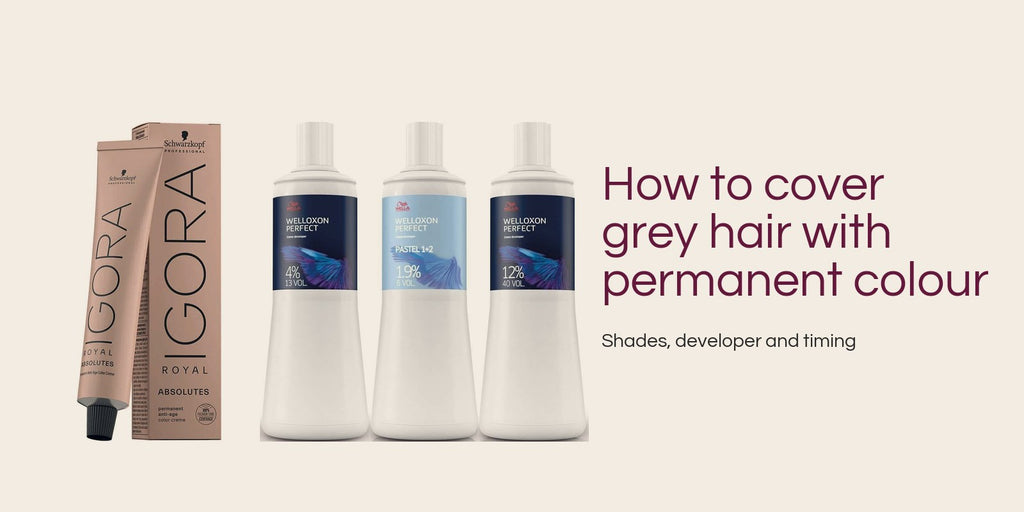
Developer is the peroxide cream mixed with the colour. Its strength is given as a percentage or in volumes, two names for the same scale: 3% is 10 vol, 6% is 20 vol and 9% is 30 vol. IGORA's developer table lists 3% for "Covering up to 100% white or grey hair", 6% for "Coverage on white hair", and 9% for "White hair coverage with IGORA ROYAL Absolutes"; the choice depends on shade family and lift. The same table lists 3% for colouring darker, 6% for tone-on-tone (same depth) and lifting 1-2 levels, and 9% for lifting 2-3 levels and for the -00 series. So with Natural and Fashion shades, 3% is the going-darker choice and 6% the same-depth or 1-2-levels-lighter choice. Wella names 6% Welloxon Perfect, and L'Oréal's US chart names 20 vol, which is also 6%.
None of these brands says going above its stated grey-coverage strength (6% for Wella, 20 vol for Majirel) improves coverage at the same depth, and none forbids it; Wella does reserve 4% for work where no grey coverage is needed. IGORA's 9% for Natural Extra and Absolutes is simply the stated developer for those shades. What these brands do offer for resistant grey is more natural shade in the mix (IGORA's 1:1 for "thick and colour-resistant hair") and dedicated shades: Koleston's XX/02 "Resistant Cool Cover" and IGORA Natural Extra, which Schwarzkopf pitches as covering "even on thick and color-resistant hair". Colourist Tracey Cunningham, in a Schwarzkopf US educator booklet, writes: "I love using 20 Vol. for optimal grey coverage, but if you're not looking to lift, try grabbing the 10 Vol. for more depth and dimension." (20 Vol. is 6%; 10 Vol. is 3%.) That's her preference, not a manual rule.
Use each brand's own developer at its printed ratio, and don't mix brands in one bowl. For oxidative hair dyes, legal limits apply "after mixing", and labels must state the mixing ratio. In other words, the legal limit is on the mixture that goes on the hair, and the ratio that makes it has to be on the label. The Cosmetics Regulation (current GB text) caps hydrogen peroxide in hair products at 12% (40 volumes). That is a legal ceiling, not a grey-coverage strength: no grey-coverage instruction in this guide goes above 9%, and the Wella and Majirel documents we checked give 12% no grey wording. If the client wants grey blended rather than covered, see our Color Touch developer guide.
How long to leave colour on resistant grey
IGORA ROYAL: 30-45 minutes. Koleston Perfect: 30-40 minutes, or 15-20 minutes with Climazon (UK fact sheet). Majirel (US chart): 35 minutes. Don't go past the brand's maximum; we found no Wella or L'Oréal source endorsing longer. Use heat only where the brand prints a heat time: Climazon is Wella's heat accelerator, and Wella's leaflet and booklet give 15-25 minutes with it, against the UK fact sheet's 15-20. The heat time replaces the no-heat time; it is not added on. We found no IGORA or Majirel heat instruction for grey coverage.
- Wella: "Apply first at the areas of the highest percentage of grey." No dry or washed-hair instruction.
- Schwarzkopf (Natural shades tip): "Always apply on dry hair", "Start to apply the product directly from the hairline", "Apply in small sections and use a generous amount of color". At the hairline, keep colour out of the eyes. For Natural Extra on fragile hair, the manual says the opposite on a first application: leave the 2cm nearest the hairline and apply there last "in order to achieve uniform coverage".
- L'Oréal (US chart): "Apply to dry, unwashed re-growth" and "Process for full development time", which on that chart is 35 minutes.
Neither brand gives a reason for the dry-hair rule. No brand document we found instructs pre-softening.
How often to retouch grey roots
Schwarzkopf's US educator booklet says: "Permanent color on higher percentage grey clients requires regular root retouches every 4–6 weeks." That is brand guidance, not a measured interval. In one small study of 24 women, half with hair-loss complaints, white hairs grew 0.38mm a day against 0.35mm for pigmented hairs, roughly 1.1cm a month by our arithmetic, close to the roughly 1cm a month usually quoted for scalp hair in general. At those rates, a 4-6 week retouch meets about 1-1.6cm of regrowth (again our arithmetic).
Retouch the regrowth only. Wella and L'Oréal both give regrowth instructions, and Schwarzkopf warns that porous hair can come out darker. To refresh lengths, IGORA's Dual-System puts IGORA ROYAL on the regrowth for 10-20 minutes, then IGORA VIBRANCE on mid-lengths and ends for another 10-20 minutes, so the roots process for 20-40 minutes in all. The manual gives this method on its Fashion shades page, not as a grey-coverage step.
Does colour fade faster on white hair? The evidence is mixed: one industry study of a single shade found more fade on white hair than dark brown under light and shampoo; another, on pre-bleached hair in water, found dye leached faster from brown. If your client wants to stop colouring, see how to return to your natural hair colour.
Questions people ask
Is grey hair porous?
Unproven either way. Porosity has no validated definition, and the few lab comparisons we found show small or no differences between grey and pigmented hair.
What developer covers grey?
Schwarzkopf lists 3%, 6% and 9% depending on shade family and lift; Wella names 6%; L'Oréal's US chart names 20 vol, which is the same strength as 6%.
Do I need to add a natural shade?
Only above each brand's threshold: IGORA Fashion shades above 70% white, Koleston from 30% grey, core Majirel above 50% white (US chart). IGORA Natural shades need no extra natural. Majirel Cool Cover needs none at level 5, and from level 6 a Natural is optional (US sources).
Should I pre-soften resistant grey?
No brand document we found instructs it.
Can I use 9% to cover stubborn grey?
For IGORA Natural Extra and Absolutes, 9% is Schwarzkopf's stated developer. Otherwise, no brand says going above its listed grey-coverage developer improves coverage at the same depth.
How long should I leave colour on resistant grey?
IGORA ROYAL: 30-45 minutes. Koleston Perfect: 30-40 minutes, or 15-20 minutes with Climazon (UK fact sheet). Majirel (US chart): 35 minutes. Don't go past the brand's maximum; we found no Wella or L'Oréal source endorsing longer.
How often should grey roots be retouched?
Schwarzkopf's US educator booklet says every 4-6 weeks for higher-percentage grey: guidance, not a measured interval. Retouch regrowth only.


