How to Use Hair Colour Correctors
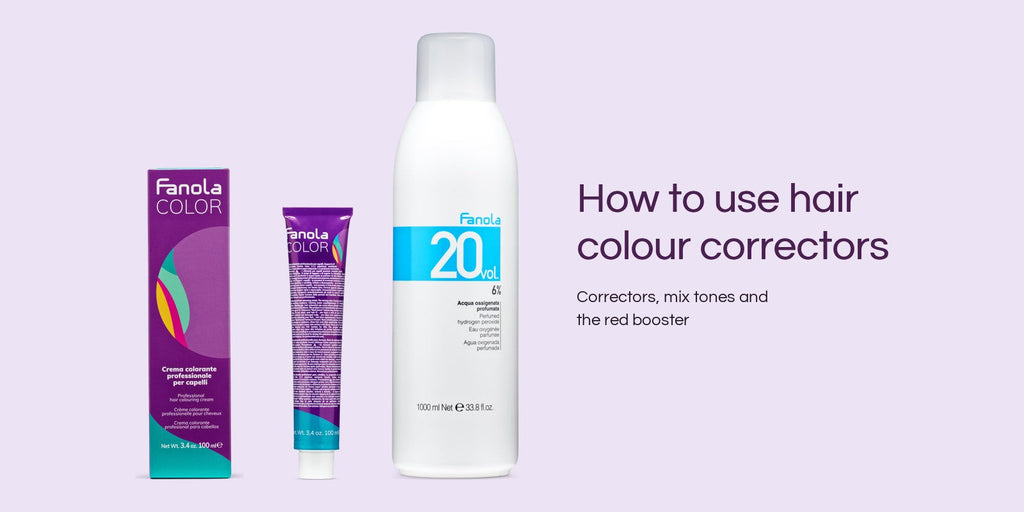
A hair colour corrector, sometimes called a mix tone, is a tone you add to a permanent colour shade to steer the result: to counter a tone you don't want, or to push one you do. The Fanola Color range has six of them (Blue, Neutral, Red, Silver, Violet and Yellow), plus the R.66 Red Booster and Color Toner Silver. They all come in the same 100ml tube as the shades and go into the same bowl. Use the amounts in the instructions in the box.
For professional use. Always follow the manufacturer's instructions for your colour, corrector and developer.
To find out more about the whole range, read Ultimate Guide to Fanola Color.

What is a hair colour corrector?
A corrector is a tone you mix into a colour shade. You use one when the shade you've chosen needs its tone adjusted for your client: a little cooler, a little warmer, or with an unwanted tone countered.
In the Fanola range, the correctors are part of Fanola Color, the permanent colour. The range is fully intermixable, so a corrector goes straight into the bowl with your chosen shade.
What is a booster for hair dye?
A corrector and a booster do different jobs. A corrector counters a tone you don't want. A booster adds more of a tone you do want.
Fanola's booster is the Fanola Color R.66 Red Booster. It's for red: add it to the bowl when you want more red in the result, at the amount the instructions in the box give.
How do hair colour correctors work?
Colourists work from the colour wheel. On the colourist's wheel, tones that sit opposite each other are treated as cancelling each other out towards a neutral result, so you pick the corrector that sits opposite the tone you want to lose. The pairs colourists use are:
- Violet against yellow
- Blue against orange
- Green against red
The same principle works the other way round: yellow sits opposite violet, and red sits opposite green. It's a working rule of the trade rather than a measured one, which is why a strand test, not the wheel, has the final say on your client's hair.
To find out more about toning yellow and orange after lightening, read Toning After Bleaching Hair.
Which Fanola corrector does what?
Here are the six Fanola Color correctors, with the tone each one sits opposite on the colour wheel. These pairings come from the colour wheel, so check the leaflet in the box for Fanola's own directions.
- Corrector Violet: sits opposite yellow, so it's the one colourists reach for against unwanted yellow.
- Corrector Blue: sits opposite orange, for unwanted orange.
- Corrector Yellow: sits opposite violet, for a result that's turning too violet.
- Corrector Red: sits opposite green, for a result with a green cast.
- Corrector Neutral and Corrector Silver: these don't sit opposite a tone on the wheel. Check the leaflet in the box for how to use them.
There's no green corrector in the Fanola Color range. The range also includes Color Toner Silver, which is a separate tube from the Silver corrector.
Can you use a hair colour corrector on its own?
We recommend mixing a corrector into a Fanola Color shade, as you would any intermixable shade in the range, rather than using it on its own, unless the leaflet in the box tells you how.
How do you mix a corrector with developer?
A corrector goes into the bowl with the shade, and then you add developer at the ratio for your technique. For Fanola Color as a permanent colour, that's 1:1.5 with Fanola Color Peroxide at 10, 20, 30 or 40 vol (or 25 vol Violet Peroxide), developed for 25-45 minutes. The R.66 Red Booster mixes at the same 1:1.5 with Fanola developer.
Check the leaflet in the box for whether the corrector counts as part of the colour when you weigh out the developer, and always mix at the ratio the pack gives.
Fanola Color has other techniques too, each with its own developer and timing, so mix the bowl for the technique you're using. Tone on tone, for example, is 1:1.5 with 5 vol Violet Peroxide for 30 minutes.
To find out more about tone on tone, read What Is Tone on Tone Hair Colour?
The Highlift shades are a different technique again: 1:2 with 40 vol, for 55-60 minutes.
To find out more about high lift colour, read High Lift Hair Colour vs Bleach.
Pro Tip: write the shade, the corrector, the developer and the exact amounts you weighed on your client's record card. When the result is right, you can repeat it exactly next time.
How to use a hair colour corrector, step by step
Fanola Color is an oxidation colour, and professional oxidation colour carries the legal label warning: "Hair colourants can cause severe allergic reactions."
- Skin test ahead of the appointment. Follow the skin test in the leaflet inside the box. Don't colour if your client has a rash on the face or a sensitive, irritated or damaged scalp, has ever reacted after colouring their hair, or has reacted to a temporary black henna tattoo. Suggest anyone who has reacted before speaks to their GP, who may refer them to a dermatologist for a patch test.
- Read the hair. Note your client's depth and the tone you want to lose or add, then choose your Fanola Color shade.
- Choose the corrector or booster. Pick the corrector that sits opposite the unwanted tone on the colour wheel, or the R.66 Red Booster to add red.
- Strand test with a small separate mix. Put on suitable gloves. Mix a small amount of shade, corrector and developer as the Fanola instructions direct, and test it on a strand from underneath to check the result before the full head.
- Mix the main bowl fresh. Just before you apply, weigh the shade and the corrector as the Fanola instructions direct, then add Fanola developer at the ratio for your technique (1:1.5 for permanent colour). Developer contains hydrogen peroxide, so avoid contact with the eyes and rinse immediately if it gets into them.
- Apply and develop. We recommend applying to dry hair. Time it for your technique: 25-45 minutes for permanent colour. Never go past the longest time on the pack, and don't add heat unless the pack instructions allow it.
- Rinse, shampoo and condition. Rinse thoroughly, then shampoo and condition, and note the formula on the record card.
To find out more about skin testing, read Hair Dye Patch Test Before Colouring.
To find out more about strand testing, read How To Do A Strand Test For Bleach.
Best Products for Correcting and Boosting Colour
A corrector, the red booster and the developer that goes in the same bowl.
 Fanola Color Corrector Red 100mlFrom a fully intermixable permanent colour range, so it mixes with the other shades to create custom colour nuances.
 Fanola Color R.66 Red Booster 100mlPart of the Fanola Color permanent oxidation colour range, mixed 1:1.5 with Fanola developer.
 Fanola Color Peroxide 20 Vol (6%) 1000mlFanola's own developer, available from 3.5 vol (1.05%) to 40 vol (12%).
Questions people ask
How much corrector should I add to hair colour?
Use the amounts in the instructions in the box, strand test first, and record what you used.
Is there a green hair colour corrector?
Green is the tone colourists use against red on the colour wheel, but the Fanola Color range doesn't include a green corrector. Its six correctors are Blue, Neutral, Red, Silver, Violet and Yellow.
Does adding a corrector change the development time?
Timings go by technique, not by corrector: 25-45 minutes for permanent colour and 30 minutes for tone on tone. Never go past the longest time on the pack.
What's the difference between a corrector and a booster?
A corrector counters a tone you don't want. A booster, like the Fanola Color R.66 Red Booster, adds more of a tone you do want.
Read next: to find out more about every Fanola colour line, read Ultimate Guide to Fanola Color.
Written by Amy-Louise Russell, Content Writer at Hairdressing Supplies.