
Permanent, Demi or Semi? Illumina, Koleston, INOA, Dia Light vs Dia Color Explained
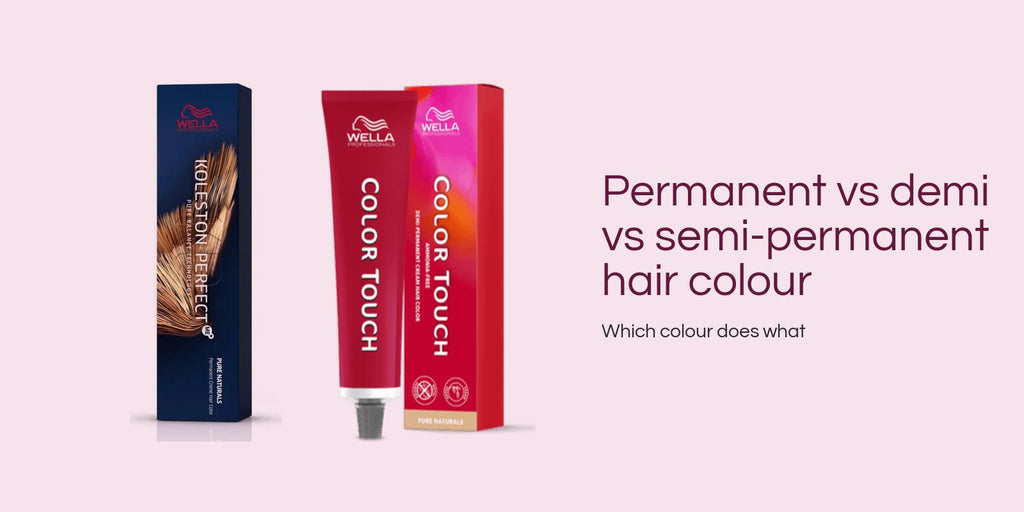
Permanent, demi and semi are trade labels, not legal categories. Their makers class Koleston Perfect, Illumina Color and INOA as permanent: up to 100% grey coverage, and colour that grows out rather than washes out. L'Oréal calls Dia Color demi-permanent (up to 70% grey coverage, slight lift) and Dia Light an acidic gloss for toning. All five use hydrogen peroxide.
Safety first. Every product here is mixed with a second bottle containing hydrogen peroxide, whatever the maker calls it: Welloxon Perfect, Color Touch Emulsion, Diactivateur or L'Oréal's INOA developer.
- Allergy alert test. Wella's Koleston Perfect fact sheet says to "always perform an allergy alert test 48h before each coloration", and that if your client "has ever experienced an allergic reaction to hair colorants, you should not color." "Each" means before every colour service, regulars included. For every other product here, follow the allergy alert test instructions in the pack leaflet. "Demi", "gloss", "acidic" and "no ammonia" don't mean you can skip it.
- Who shouldn't be coloured. UK cosmetics rules attach the same label wording to many oxidative dye ingredients, including PPD and PTD: "Hair colourants can cause severe allergic reactions", "This product is not intended for use on persons under the age of 16", and "Do not colour your hair if: you have a rash on your face or sensitive, irritated and damaged scalp, you have ever experienced any reaction after colouring your hair, you have experienced a reaction to a temporary 'black henna' tattoo in the past." Which ingredients a given colour contains is on its pack; the allergy alert test applies either way.
- Gloves and eyes. UK cosmetics rules require hair products containing hydrogen peroxide to carry these warnings: "Wear suitable gloves", "Contains hydrogen peroxide", "Avoid contact with eyes", "Rinse immediately if product comes into contact with them."
- Developer. Mix only with the developer the maker names, at the strength and ratio it gives. The maker's lift, grey-coverage and timing figures are for that combination, and the ratio sets how strong the mix is: at 1:1, a 6% developer starts at roughly 3% in the bowl. For scale, UK rules cap hydrogen peroxide in a hair product, as ready for use, at 12% (40 volumes).
Permanent, demi or semi at a glance
Every label and figure is the manufacturer's own claim; US wording is marked.
| Product | Maker's label | Mixed with | Maker's grey-coverage claim | Maker's lift claim |
|---|---|---|---|---|
| Wella Koleston Perfect | "a permanent color range" | Welloxon Perfect, 1:1 | Up to 100% | 1, 2 or 3 levels with 6%, 9% or 12% |
| Wella Illumina Color | "a permanent color range" | Welloxon Perfect, 1:1 | Up to 100% | Up to 3 levels |
| L'Oréal INOA | "Ammonia-Free Permanent Haircolor" | INOA developer, 1:1 | Up to 100% (with iNOA or Majirel) | See the pack leaflet |
| L'Oréal Dia Color | "Demi-permanent colour with no ammonia" | Diactivateur, 1:1.5 | Up to 70% | In most cases up to 1 level with 15 vol (US) |
| L'Oréal Dia Light | "acidic gloss color" | Diactivateur, 1:1.5 | None (US) | None (US) |
| Wella Color Touch | "a demi-permanent hair color" | Color Touch Emulsion 1.9% or 4%, 1:2 | Up to 70%, with Color Touch Plus only (standard Color Touch: up to 50%, Wella UK 2020) | "can lift the natural melanin" (US) |
What permanent, demi and semi actually mean
The law doesn't define them. UK cosmetics rules sort hair dyes as "oxidative" (the colour forms inside the hair when the dye reacts with the peroxide developer) or "non-oxidative" (ready-made dyes, no developer); in our search of the current ingredient annex, the words permanent, demi and semi don't appear. Procter & Gamble patents state that "there is no official definition" separating demi from permanent. In the most common usage:
- Semi-permanent means ready-made dyes with no hydrogen peroxide. It can't lighten and needs no mixing. The UK trade body CTPA says it normally lasts "up to 6-8 washes". Usage isn't uniform: one 2022 review uses "semipermanent" to include oxidative dyes too.
- Demi-permanent is oxidative. A 2015 review describes it as "a mix of semipermanent molecules with oxidation dye precursors, applied with hydrogen peroxide", differing from permanent mainly in the alkaliser, the ingredient that makes the mix alkaline and is credited with opening the hair to let colour in and helping the peroxide lighten natural pigment. The CTPA says demi doesn't significantly lighten natural pigment, though some demis claim a little lift, and that it "will gradually wash out after approximately 28 shampoos".
- Permanent is oxidative too, and the makers here promise lift (lightening of the natural colour) and up to 100% grey coverage. It grows out rather than washes out, but isn't fade-proof: a 1984 Clairol paper described "little fading during the six-week period before recoloring is necessitated by the new hair growth."
Published wash counts disagree: a 2015 review gives semi three to six washes and demi up to 20, against the CTPA's 6–8 and about 28. So compare longevity within a brand, not across brands. How permanent and demi colour form inside the hair is covered in our guide to colour remover vs bleach.
Why the labels look contradictory
In the body copy of their product pages, neither Wella nor L'Oréal calls Koleston Perfect, Illumina Color, INOA, Dia Color or Dia Light semi-permanent. Page titles, which are what Google shows in search results, sometimes do:
- Wella's UK Color Touch page is titled "Color Touch Semi-Permanent Hair Colour"; its FAQ says "Wella Color Touch is a demi-permanent hair color".
- L'Oréal's UK page at lorealprofessionnel.co.uk/dia-color is titled "DIA Semi Permanent Hair Colour" and its description says "our semi-permanent, tone-on-tone hair colour", while the page body says "Demi-permanent colour with no ammonia".
One UK retailer's Dia Light guide uses both words on the same page. When labels clash, trust the classification in the maker's product copy or pack leaflet, not a page title or a shop category.
How to tell which type you've got
No manufacturer or trade body publishes an official test. This is a rule of thumb, not a definition:
- Is it mixed with a second bottle? Wella calls it Welloxon or Emulsion, L'Oréal Diactivateur or Oxydant, Schwarzkopf Activator. Every product in this guide is mixed with hydrogen peroxide, which in the usual usage rules out semi-permanent and means the allergy alert test and gloves apply. A colour sold ready to use is the semi-permanent case.
- Read the maker's own classification word in the product copy or leaflet.
- Treat the claims as clues. Permanents promise several levels of lift and up to 100% grey coverage. Demis talk about deposit, gloss, partial grey coverage and fading over a number of washes, though some claim about 1 level of lift.
Chemistry alone won't settle it. Developer strengths overlap: Wella's demi Color Touch uses 1.9% or 4%, while permanent Koleston Perfect uses 4% Welloxon Perfect, and 1.9% Pastel for pastel toning. INOA is a permanent made without ammonia (its alkaliser is MEA, or ethanolamine), and Wella describes Color Touch Plus, one of its demis, as "low-ammonia". So the developer bottle tells you the colour is oxidative, which means the allergy alert test and gloves; it doesn't tell you whether it's demi or permanent.
Is Wella Illumina permanent?
Yes, according to Wella. Its technical folder calls Illumina Color "a permanent color range" used with Welloxon Perfect developer, giving "up to 3 levels of lift", and Wella's UK page calls it "a permanent creme hair color" with "up to 100% grey coverage". Mix 1:1 (60 ml colour, 60 ml Welloxon Perfect); Wella's technical folder doesn't give a strength per result, so take it from the pack leaflet. Wella says Illumina is "Not recommended for mixing with Koleston Perfect".
Illumina is also used for toning: Wella's US store blog formulas use it 1:2 with 1.9% Welloxon Perfect Pastel. Our reading is that a low-strength toning use doesn't change Wella's classification. Used as a toner it's still mixed with a hydrogen peroxide developer, so the allergy alert test and gloves apply as they do for any Illumina service. Wella's UK page and technical folder don't say whether Illumina contains ammonia.
Is Wella Koleston Perfect permanent?
Yes. Wella's fact sheet calls it "a permanent color range used with Welloxon Perfect developers NEW 4%, 6%, 9%, 12% and 1.9% Welloxon Perfect Pastel for pastel toning", with "Up to 100% coverage of gray/white hair". Mix 1:1 and develop for 30–40 minutes without heat, or 15–20 minutes with heat. Developer strength sets the result: 12% for 3 levels of lift, 9% for 2, 6% for 1 level and grey/white coverage (or the same depth or darker), and 4% for the same depth or darker when no grey coverage is needed. Special Blondes mix 1:2 and develop for 50–60 minutes (25–35 with heat), giving 4–5 levels at 12% and 3 at 9%. Wella's pastel toning service mixes Koleston 1:2 with 1.9% Welloxon Perfect Pastel; in our reading, as with Illumina, that doesn't change the classification.
ME+ is a formula change: Wella describes ME+ as an "oxidative permanent hair dye molecule" that replaces PTD and PPD (toluene-2,5-diamine and p-phenylenediamine), and says ME+ is present in specific shades of Pure Naturals, Rich Naturals, Vibrant Reds, Special Blonde and Deep Browns, not the whole range. UK rules require ME+ (listed as 2-methoxymethyl-p-phenylenediamine) to carry the same allergy warnings as PPD and PTD, quoted in the safety box above. Launch coverage relayed Wella's message of "the same mixing ratio, the same development time and the same grey coverage", alongside easier mixing, more precise application and an improved fragrance. Wella says ME+ reduces the risk of developing a new allergy, but only "FOR PEOPLE NOT ALLERGIC TO HAIR COLORANTS"; it says a risk of severe reaction remains, an allergy alert test 48 hours before each colouration is still required, and clients who have ever reacted to hair colourants should not be coloured.
Is L'Oréal INOA permanent?
Yes, according to L'Oréal. Its UK developers page says the INOA developer "is formulated to be used with INOA Ammonia-Free Permanent Haircolor with ODS² technology" (the same page labels the developer "oil delivery system"), and this time the UK INOA product page title agrees: "No Ammonia Permanent Hair Colour". L'Oréal UK gives "Mixing ratio 1:1 Development time: 35min" with its own INOA developer; take the developer strength from the pack leaflet. L'Oréal UK says "Up to 100% grey coverage with iNOA or Majirel".
L'Oréal says its ODS technology "propels the pigments inside the fiber, therefore eliminating the need of ammonia"; INOA uses MEA (ethanolamine) instead. So "ammonia-free" tells you nothing about whether a colour is demi or permanent, its lift or how long it lasts. Nor does it make a colour suitable for anyone who has reacted to hair dye; the allergy alert test still applies. And a pack without an ammonia warning isn't necessarily ammonia-free: UK rules only require "Contains ammonia" above 2% ammonia, and cap it at 6% (as NH3).
Dia Light vs Dia Color
L'Oréal says both are ammonia-free; both mix with Diactivateur at 1:1.5 (1 part colour to 1.5 parts developer). L'Oréal US sums up the difference: "Dia color is an alkaline demi-permanent color and Dia light is an acidic demi-permanent color."
L'Oréal gives developer strength in volumes ("vol"), Wella in percent. L'Oréal UK prints 6 vol as 1.8% and 9 vol as 2.7%, and the usual trade conversion is 10, 20, 30 and 40 vol to 3, 6, 9 and 12%. So Dia Light's developers sit in the same low range as Color Touch's 1.9% and 4% emulsions, well below the 6–12% Koleston uses for lift.
| Dia Color | Dia Light | |
|---|---|---|
| Maker's label | "Demi-permanent colour with no ammonia" (UK); "alkaline demi-permanent" (US) | "acidic gloss color" (UK); "Acidic crème demi-permanent gloss color" (US) |
| Developer (UK) | Diactivateur 6, 9 or 15 vol maximum; L'Oréal says not to use hydrogen peroxide above 15 vol | Diactivateur 6 or 9 vol only |
| Time (UK) | 20 minutes, first application on dry, unwashed hair | 20 minutes on dry hair; 5–20 minutes for toning on shampooed, towel-dried hair |
| Grey coverage | "Up to 70% grey coverage" | None (US) |
| Lift (US) | In most cases up to 1 level with 15 vol; up to 1.5 levels for certain shades on fine hair | None |
| Best on (US) | Natural or coloured hair | Coloured or lightened hair |
So Dia Color is the one for some grey coverage or a slight lift. L'Oréal US defines "coverage" as white hair "entirely opacified (or with a very slight transparency)", but doesn't say whether "up to 70%" means clients up to 70% grey or 70% of the grey covered; in our reading, for a mostly grey client who wants full coverage, both makers point to their permanents. Dia Light is a gloss and toner for coloured or lightened hair: L'Oréal UK describes it for glossing, toning and taking through, listing toning "after lightening" and refreshing faded lengths "after a root coverage". L'Oréal US says it won't lift or cover grey. For picking a toner shade, see what toner to use after bleaching. L'Oréal US also says Dia Color replaces Dia Richesse.
Where Wella Color Touch fits
Color Touch is Wella's demi-permanent, and Wella's current pages say it "fades over 28 washes" (its 2020 fact sheets said up to 15 or 24 shampoos). It's mixed 1:2 (1 part colour to 2 parts emulsion) with Color Touch Emulsion 1.9% or 4% for 20 minutes (see choosing 1.9% or 4% Color Touch developer). Read the grey claim carefully: "Up to 70% grey coverage" is footnoted "with Color Touch Plus", and Color Touch Plus is the exception to Wella's "ammonia-free" claim. Wella's 2020 UK fact sheet put standard Color Touch at "Up to 50% white coverage" and Color Touch Plus at "Up to 70% white coverage", with Color Touch Plus mixed only with its own Plus Emulsion 4%.
Questions people ask
Is Dia Light semi or demi-permanent?
L'Oréal doesn't call it semi-permanent on any page we checked: the UK page says "acidic gloss color", the US page "Acidic crème demi-permanent gloss color". It's mixed with Diactivateur, which contains hydrogen peroxide, so follow the leaflet's allergy alert test instructions.
Does Dia Light cover grey?
No. L'Oréal US says Dia Light "provides no grey coverage or lift". For grey coverage, L'Oréal UK pairs it in a routine with INOA or Majirel.
Which developer and timing do Dia Light and Dia Color use?
Both mix with Diactivateur at 1:1.5, and L'Oréal UK says to use them only with its recommended Diactivateurs. Dia Light: 6 or 9 vol only; 20 minutes on dry hair, or 5–20 minutes for toning on shampooed, towel-dried hair. Dia Color: 6, 9 or 15 vol maximum, and L'Oréal says not to use hydrogen peroxide above 15 vol; 20 minutes, first application on dry, unwashed hair.
Can I use Dia Light after INOA or Majirel?
L'Oréal UK pairs them in a routine: it gives "Up to 100% grey coverage with iNOA or Majirel", and lists Dia Light for refreshing faded lengths "after a root coverage". Dia Light is still mixed with Diactivateur, so follow the pack leaflet's allergy alert test instructions.
Has Dia Color replaced Dia Richesse?
L'Oréal US says Dia Color replaces Dia Richesse. That's US wording; in the UK, L'Oréal sells Dia Color as a demi-permanent with "Up to 70% grey coverage", mixed with Diactivateur at 1:1.5.
Do I need an allergy test for demi-permanent or gloss colour?
Yes: follow the allergy alert test instructions in the pack leaflet, every time, even for a client who has had colour before without a problem. Every product in this guide is mixed with hydrogen peroxide, and "demi", "gloss", "acidic" or "no ammonia" say nothing about allergy risk. L'Oréal's own footnote gives the reason for Dia Color's "no ammonia" as "for a pleasant smell".
Can demi-permanent colour cover grey?
Partly. L'Oréal says Dia Color gives "Up to 70% grey coverage". L'Oréal US defines coverage as white hair made opaque, but doesn't say what the 70% measures: clients up to 70% grey, or 70% of the grey covered. Wella's 70% figure for Color Touch applies only with Color Touch Plus, which isn't ammonia-free; its 2020 UK fact sheet gave standard Color Touch "Up to 50% white coverage". Wella's and L'Oréal's up-to-100% grey coverage claims are for their permanents, so for a mostly grey client who wants full coverage, that's where both makers point.
Can I mix Illumina and Koleston?
Wella says Illumina Color is "Not recommended for mixing with Koleston Perfect". We found no manufacturer guidance on mixing a permanent and a demi in one bowl, so we can't advise on it.
Products mentioned
- Wella Koleston Perfect ME+: permanent, with Welloxon Perfect.
- Wella Illumina Color: permanent, with Welloxon Perfect.
- L'Oréal Professionnel INOA: ammonia-free permanent, with INOA developer.
- L'Oréal Professionnel Dia Color: demi-permanent, with Diactivateur.
- L'Oréal Professionnel Dia Light: acidic gloss colour, with Diactivateur.
- Wella Color Touch: demi-permanent, with Color Touch Emulsion.
Some shops, including ours, call Dia Light or Color Touch "semi-permanent". Both are mixed with a peroxide developer, so the allergy alert test and gloves apply.
Browse all permanent hair colour.


