How to Enhance Your Natural Curls (What Each Step Actually Does)
On our reading of the evidence, enhancing your natural curls comes down to three jobs: getting strands to group into clumps, fixing that shape while the hair dries, and slowing how fast damp air loosens it. In practice that means conditioning, putting a gel or mousse on while the hair is still damp, and letting it dry in the shape you want; conditioner, leave-in, styler and drying each play a different part. Almost every test of curl products was run by the companies that make them or their ingredients, and we found no independent study measuring curl definition on real heads.
If you want a quick routine, start with our guide on how to make your curls more defined. This one goes step by step through why each part works, or might not.
What "defined curls" and "frizz" actually mean
There is no agreed measurement of a "defined" curl. Our working reading, which is our own and not from a study, is that defined curls are strands held together in bundles, or clumps. The physics usually used to explain clumping comes from models, not hair: arrays of flexible strips pull together into bundles as liquid drains or dries off them. In a computer model, softer elements formed bigger clusters. We found no measurement of clump size on human hair.
Frizz has no agreed definition either. One researcher at TRI Princeton, a hair research institute, defines it as hair that can't line up neatly, or loses that alignment after a while. That covers natural curl, static flyaways and humidity. A L'Oréal patent describes it in similar terms: strands that aren't aligned, or stray strands.
Why curls frizz, drop and fall apart
Humidity
The clearest numbers are for curl set into hair, not natural curl. In Clairol's 1983 roller tests, a curl set with water and dried lost half its curl in about 4 minutes at 90% humidity, against about 43 minutes at 65%: roughly ten times faster in the damper air. That was one hair source, and the paper doesn't say how many times each test was repeated. Unilever tests found set curls lost more curl as humidity rose. Water also softens hair: in Croda's tests on single hairs (the untreated ones were not curly), stiffness fell steadily as humidity went from 50% to 80%.
For natural, unset curl there are only photographs. A Croda tress labelled "frizzy" got bigger and curlier going from 50% to 80% humidity, and Dow described untreated tresses as "very frizzy" after 4 hours at 90%. We found no study that puts numbers on how natural curl responds to humidity.
Weight
In experiments on hanging curved rubber rods (not hair), the rods took one of three shapes; in one, the upper part stayed straight because it carries the weight below it. In Colgate's tests, single hairs given a water-set curl uncoiled under their own weight: four 30 cm hairs measured 11.3–19.6 cm after a week (against 30 cm if fully straight) and were still stretching, even at a fairly dry 40% humidity. Thicker hairs resisted uncoiling better, and added weight cut curl retention further. That was set curl on single hairs, not natural curl on a head, but it points the same way: heavy product on the lengths is unlikely to help (our reasoning, not a measured result). If you want fuller curls, see our guide on how to make curly hair thicker.
Handling
"Don't touch your curls" is common advice. In models, a dried bundle either stays stuck or splits apart depending on whether the stickiness beats the strands' springiness. We found no study measuring frizz after touching or combing dried curls.
Step 1: Conditioner
Conditioner works mainly by leaving material on the hair's surface. Measurably, it cuts friction, combing force and breakage while you detangle. In a TRI Princeton test on bleached hair (the paper makes no statement about industry funding), one rinse-off conditioner cut short broken pieces after 100 dry comb strokes from about 111 to 39, roughly 65% fewer (three tresses per group). In an industry-linked test, conditioner after a silicone-and-oil shampoo lowered breakage further on bleached hair but made no measurable difference on unbleached hair.
In one independent X-ray study on one person's hair, a diluted rinse-off conditioner left no detectable change inside the strand.
On curls specifically, the nearest evidence is from silicone maker Momentive, testing its own silicones applied neat from a solvent, not in a conditioner. At 75% humidity, treated curly tresses kept their strands more parallel and less bulky than untreated ones, judged from photographs. We found no study showing that smoother, lower-friction hair forms better clumps.
How long to leave it on? We found no study measuring a conditioning benefit against time. The "3–10 minutes for a mask" figure is a manufacturer's category definition in a Unilever patent, not a test result.
Step 2: Leave-in conditioner
In GB cosmetics law a leave-in is a "leave-on" product, made to stay on the hair. Some of the same conditioning ingredients are allowed only at lower levels in leave-ons: cetrimonium chloride, for example, is capped at 2.5% in rinse-off hair products and 1.0% in leave-ons, and two preservatives (methylisothiazolinone and its mix with methylchloroisothiazolinone, listed as MI and MCI/MI) are allowed in rinse-off products only. So a rinse-off conditioner left in is not a leave-in: it can legally contain more of these ingredients. We found no study measuring what leaving a rinse-off conditioner on for hours does to hair, so for that job use a product made as a leave-in (our practical reading of the rules).
The only curl evidence we traced for leave-ins is patents. According to one L'Oréal patent, a leave-in with a sugar and a chelating agent (an ingredient that binds metals) gave "better curl definition, frizz control" on mannequin heads with curly hair after an hour at 80% humidity. That was described in words, with no scores or statistics. We found no study comparing the same leave-in put on wet versus dry hair.
You'll often read that glycerin frizzes curls above a certain "dew point" (a measure of how much moisture is in the air). We found no measurement behind that rule. In the one patent example we found, adding 1% glycerin to a styling polymer did not reduce how well curls held at 90% humidity (70% of the curl kept after 8 hours, against 50% without), though the same patent claims, without data, that humectants usually do with other styling polymers. On what we found, there is no measured reason to avoid glycerin on humid days, and no proof it helps either.
Step 3: Gel and mousse
Styling polymers dry into a film. In supplier research the dried gel is described as glue between strands, making a composite that resists curls slowly stretching out. The clearest number is again Clairol's: at 90% humidity, a sprayed styling resin (5.8 mg per gram of hair) stretched a water set's half-life (the time to lose half its curl) from 0.07 hours (about 4 minutes) to 1.32 hours (about 80 minutes), roughly 19 times longer. More resin meant longer hold: the lightest dose tested (1.6 mg per gram) made almost no difference. That was one resin on one hair source, with no replicate counts.
Suppliers say damp air softens the film too, though they did not measure it directly. In Ashland's tests of three polymers on straight hair, the authors put the onset of failure between 60% and 70% humidity; by their stiffness measure, two polymers began to fail at 70% and one at 80%. In Lubrizol's tests, one gel made with triethanolamine held curls less well over 8 humid hours than the same gel made with other neutralisers (significance not reported). The authors put it down to triethanolamine softening the film and drawing in water.
Mousse is a water-rich foam, and suppliers list the same kinds of styling polymers for mousses as for hairsprays. One review says mousses "do not form rigid bonds" and work by strengthening the forces between strands, though it gives no measurement. We found no study measuring whether mousse reduces frizz on curly hair, and the idea that a film holding clumps together reduces frizz is plausible but unproven.
Step 4: Drying
Hair dried while held in a shape keeps that shape for a while: a water set. A 1982 review explains it as weak bonds in the hair (it names hydrogen bonds and ionic attractions, among others) breaking when wet and re-forming in the new shape as the hair dries. A later model paper explains it differently, and we found no experiment that separates the two. The review also says water releases the set.
So the shape your curls are in as they dry is the shape that sets (our inference from the above). By the same reasoning (also ours), a styler put on damp hair is already there while that shape forms. Re-wetting curls on day two would logically make a fresh set, but we found no study measuring it.
We found no study of plopping, scrunching or diffusing (one search pass for each). Two published case reports link tight overnight rollers or ponytails to hair loss from pulling (traction alopecia). Case reports show something can happen, not how often it does, so keeping overnight styles loose is our cautious suggestion, not a tested one.
In one donor's hair (curl type not measured), strands stretched about 44% before snapping when wet, against about 27% at 65% humidity. We found no comparison of wet versus dry detangling by natural curl type. One Colgate test found combing easier wet than dry on tightly curled hair, but that curl was steam-set into Caucasian hair.
What is still unproven
- Sulphate-free and silicone-free routines. We found no study measuring curl definition, frizz or breakage on these routines, so it isn't established either way. For salons, see our piece on the curly girl method.
- Protein–moisture balance. We found no study that defines or demonstrates "protein overload" or "moisture overload".
- Curl training. We found no study showing a routine turning wavy hair curly over time.
For frizz on any hair type, see how to remove hair frizz.
Questions people ask
How do I enhance my natural curls?
Condition to cut friction and breakage, use a styling film to hold the shape, and let the hair dry in the shape you want. Leaving it alone until dry is sensible, though not measured. Most of the curl-specific evidence comes from product and ingredient makers, so judge by your own results.
How do I get rid of frizz in curly hair?
Damp air loosens set curl fast, and styling films slow that down in manufacturer tests. Suppliers say films soften in humid air too, so expect less hold on very damp days. We found no study measuring frizz after touching dry curls.
Is curly hair drier than straight hair?
No peer-reviewed study has shown it. Lab comparisons sort hair by ancestry, not measured curl, and in one (a single sample per group, and only the curliest was heat-treated) the curliest hair had the most lipid (fatty material). We found no measurement of whether scalp oil travels less far down curly hair.
Products mentioned
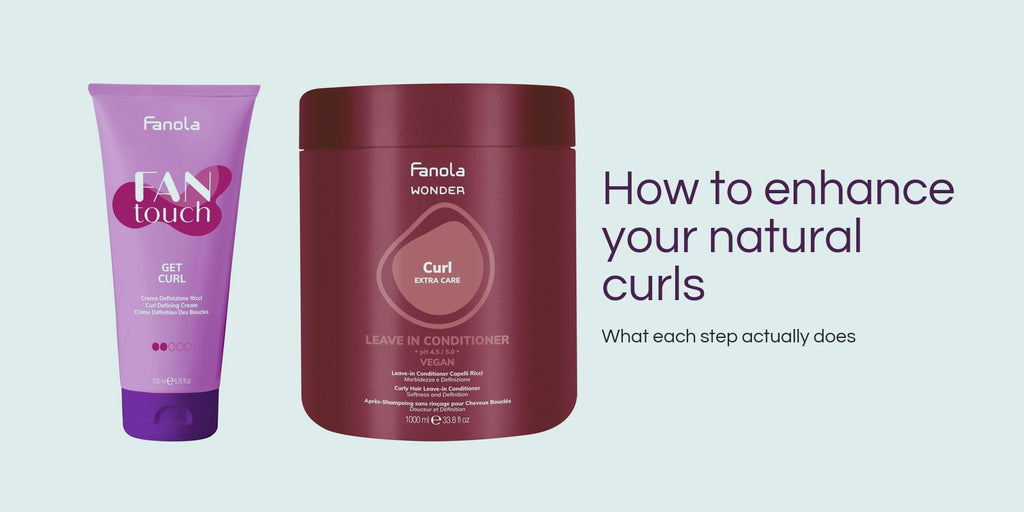
- Fanola Wonder Curl Washing Conditioner 350ml
- Fanola Wonder Curl Leave-in Conditioner 1000ml
- Fanola Fantouch Curl Passion Curl Mousse 300ml
- Fanola Fantouch Get Curl Defining Cream 200ml
More on the range: our guide to the Fanola Wonder Curl range.
Sources (as summarised in our hair-chemistry research notes): Bico 2004, Py 2007 and Singh 2014, clumping in model fibre arrays; Evans 2024 (TRI Princeton), definition of frizz; L'Oréal patents US 12,263,238 and US 12,290,589; Diaz & Wong 1983 (Clairol), humidity and water sets; Breuer 1972 (Unilever); Gao 2007 (Croda); Keenan 2011 (Dow); Miller 2014, hanging curved rods; Robbins 1983 (Colgate); Robbins & Reich 1986 (Colgate), combing curled hair; Kamath 1984 (TRI), wet and dry stretch; Wei 2015; Robbins & Kamath 2007, J Cosmet Sci 58:477–484; Davies, Wortmann & Wortmann 2026, PubMed 40931462; PeerJ 2015 X-ray study, PMC4636411; Dussaud & Fieschi-Corso 2009 (Momentive); Unilever patent WO2025078216A1; GB Cosmetics Regulation 1223/2009, Annexes III and V; patent US 6,410,005; Rafferty 2008 (Lubrizol); McMullen & Gillece 2023 (Ashland); Gavazzoni Dias 2015, Int J Trichol; Feughelman 1982 (review); Wortmann 2010; Samrao 2021, traction alopecia case reports; Barba 2022.