How to Make Curly Hair Thicker (and What Actually Works)
You can't thicken curly hair you already have from the inside, but you can make it look fuller and keep more of it. The visible hair is non-living, and we found no verified evidence that any product or routine permanently changes how many hairs you have or how wide they grow. What does work: keeping the lengths you have from breaking, lifting the roots, keeping weight off the curl, and treatments that widen each hair for a while. Curly hair is also not thinner strand for strand than straight hair. It is flatter in cross-section and shrinks up, which can make it look like less.
This guide sticks to what has actually been measured, and says so where nobody has measured it. For thickening advice that isn't curl-specific, see our guide on how to thicken hair naturally.
Is curly hair thinner than straight hair?
Not by the measure that counts. In a Unilever-funded study of 170 US adults, about 160 hair cross-sections per person were measured under an electron microscope. The cross-sectional area (how much hair is in each strand) did not differ significantly between curl types. The shape did: the curlier the hair, the more oval it was.
A smaller University of Cape Town study, one donor per curl type, found the same trend on average. Low-curl hair was about 1.3 times as wide one way as the other, and tightly curled hair about 1.7 times, though the ranges overlapped considerably between curl types. The authors of the larger study stress that the link between curl and oval shape is a correlation, not a cause.
So what does that mean for you? A flatter, oval strand is the same amount of hair as a rounder one, just a different shape. If curly hair looks thin, the cause is usually how the curls sit together, how much they shrink, or real thinning at the scalp. It is rarely that each hair is skinnier.
Why curly hair can look thinner than it is
Shrinkage
Curls take up length. In one lab paper, tightly curled hair stretched out to about 2.25 times its relaxed length. That means it sat at roughly 44% of its full length, about 56% shrinkage. That figure comes from a five-fibre sample, so treat it as an example, not a rule. The "75% shrinkage" figure you will see quoted online did not turn up in any peer-reviewed source we checked. Shrinkage makes hair look shorter. No study has put a number on whether it changes how full the hair looks.
Weight at the root
Many people with curly hair find their roots sit flat and straight while the ends curl. In lab experiments on curved rubber rods, which are not hair, the top of a hanging curved rod stayed straight because it carries the weight of everything below it. The curl formed lower down. Hair points the same way: in commercial hair samples, curl got tighter from the root end to the tip, though the authors put part of that down to how the hair dried. Nobody has measured this on curly hair growing from a real head. It is a reasonable explanation for flat roots, and it is why adding weight to the lengths can make it worse.
Clumping
"Defined" curls are curls that hold together in clumps. In model experiments with flexible strips pulled out of a liquid, the strips pull together into bundles as they leave the liquid or dry. That is the physics usually used to explain curl clumps. No study has measured clumps on human hair. One honest consequence (our inference): bigger, tighter clumps can leave more scalp showing between them. If the hair looks thin at the parting, slightly smaller clumps may look fuller than a few large ones.
What thickening products actually do to curly hair
Thickening shampoos, conditioners and leave-ins work on hair that already exists. They coat the strand, swell it slightly, or hold strands away from the scalp. None of them adds hairs.
The best numbers come from manufacturers' own tests. In one patent from ELC Management (an Estée Lauder company, though the patent itself doesn't say so), the best treatment widened lab samples of blonde hair by about 18%. After 20 washes about 9% remained. But a three-step placebo routine with no active ingredient also widened the hairs by about 10% straight away. After 20 washes the best treatment was not significantly better than that placebo routine on width, though it was significantly better on cross-sectional area. We found no independent test of how long any retail thickening product lasts.
In practice: expect a thickening product to make each strand feel and look a little fuller for a while, from what it deposits on or in the hair. In that test, a routine with no active ingredient got part of the way on its own. Neither changes the hair that grows next.
Styling products help in a different way. A dermatology review notes that gels, mousses and sprays hold hair away from the scalp, giving "an illusion of fullness". On curly hair that means lift at the root rather than a heavier coating on the lengths. We found no study that measured which curl products add or remove volume, so judge by the result on the hair in front of you.
How to thicken curly hair: making thin curls look fuller
- Keep the hair you have. Fewer broken lengths means more hair at the ends, which is where thin curly hair often looks sparse. Bleach matters here: in one lab test on straight European hair, once-bleached hair shed about three times more broken fragments than unbleached hair when combed dry 5,000 times.
- Detangle gently, and know your hair's state. In one donor's hair, fibres stretched about 44% before snapping when wet, against about 27% at room humidity. That is one person's hair, and wet versus dry detangling hasn't been compared by curl type, so the practical rule is simply to go gently: work from the ends up and don't force a comb through knots.
- Lift the roots, keep weight off the lengths. Use root lift from a styling product rather than piling heavier products onto the ends. This follows from the root-weight point above; it is reasoning from the physics, not a measured result.
- Avoid tight styles worn every day. Hair loss from constant pulling (traction alopecia) has been linked to tight ponytails and tight overnight rollers in published case reports. That is only two reported cases, not a measured risk, but there's no upside to constant tension either.
- Use concealers for the scalp, not the lengths. Hair-thickening fibres reportedly cling to existing hairs by static. A dermatology review says they have "limited utility" on completely bald areas, so they only help where there is still hair to hold on to.
Can you make curly hair thicker naturally, or permanently?
Not the hair you already have. Above the scalp, a hair is non-living keratin, so nothing you put on it or eat can regrow it or permanently enlarge it; treatments only widen it for a while. How wide a new hair grows is linked to the follicle: in human follicles, the size of the hair's core correlates with the size of the follicle's base (strongly in facial hair, more weakly on the scalp). We found no verified evidence that any cosmetic permanently increases hair width or the number of follicles.
New growth is slow. Scalp hair grows about 0.27–0.43 mm a day on average (group averages from a study of adults aged 18–35), so roughly 8–13 mm a month. Anything that changes new growth would take months to show at the lengths.
Is it fine curly hair, or thinning?
In this guide, fine means each strand is narrow and thin means fewer hairs per square centimetre of scalp. Usage varies, though: some studies call narrow hairs "thin". For thin hair in general, see our guide on how to thicken thin hair. Curly hair that has always been this way is usually just how it grows. If hair is getting noticeably thinner over time, or shedding suddenly, that can have medical causes. If you are worried, see a GP rather than trying to fix it with products; a dermatologist can work out the cause.
Questions people ask
How do I make my curly hair thicker?
You can't permanently increase the number or width of hairs you already have. You can make curly hair look thicker: protect the lengths from breakage, lift the roots, keep heavy product off the ends, and use thickening products that coat each strand for a while.
How do I thicken thin curly hair?
If it has always been fine, work on volume: root lift, gentle detangling and fewer bleach services. If it is getting thinner, or there is more scalp showing than there used to be, see a GP if you are worried.
Is curly hair thinner than straight hair?
Not strand for strand. A study of 170 adults found no significant difference in the cross-sectional area of the hair between curl types. Curlier hair is more oval in cross-section, and it shrinks up, which can make it look like less.
Do thickening shampoos work on curly hair?
They coat the strands so each hair is slightly wider for a while. The figures all come from manufacturers' tests. In one, about half the gain had gone after 20 washes, and by then it was not significantly wider than hair given a placebo routine with no active ingredient.
Products mentioned
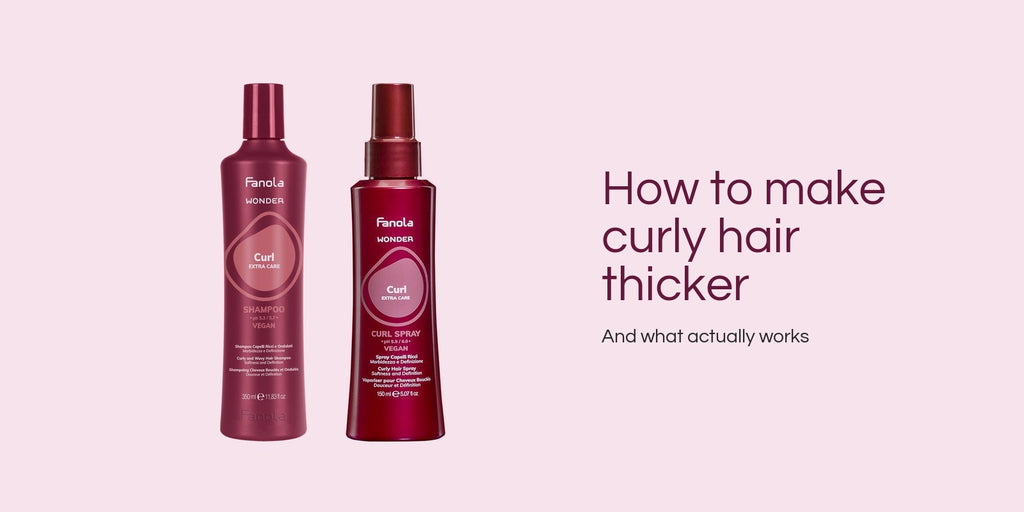
More on curls: how to make your curls more defined and our guide to the Fanola Wonder Curl range.
Sources: Richena M et al. 2025, curl type and hair cross-section in 170 US adults (Unilever-funded), PubMed 40162489. van den Berg, Khumalo & Ngoepe 2025, J Microsc, PubMed 39564786. McMullen 2015 (Ashland), curl index of curly hair; Miller et al. 2014, shapes of hanging curved elastic rods; Goldstein et al. 2012 (Unilever co-author), curvature of hair in commercial switches; Samrao et al. 2021, traction alopecia case reports (these four as summarised in our hair-chemistry research notes). ELC Management LLC (an Estée Lauder company) patent CA2875283C. Daruwalla, Dhurat & Hamid 2022, Int J Trichol, PubMed 35755961. Davies, Wortmann & Wortmann 2026, combing breakage of bleached hair, PubMed 40931462. Loussouarn et al. 2016 (L'Oréal), hair growth rate, PubMed 27019510.