
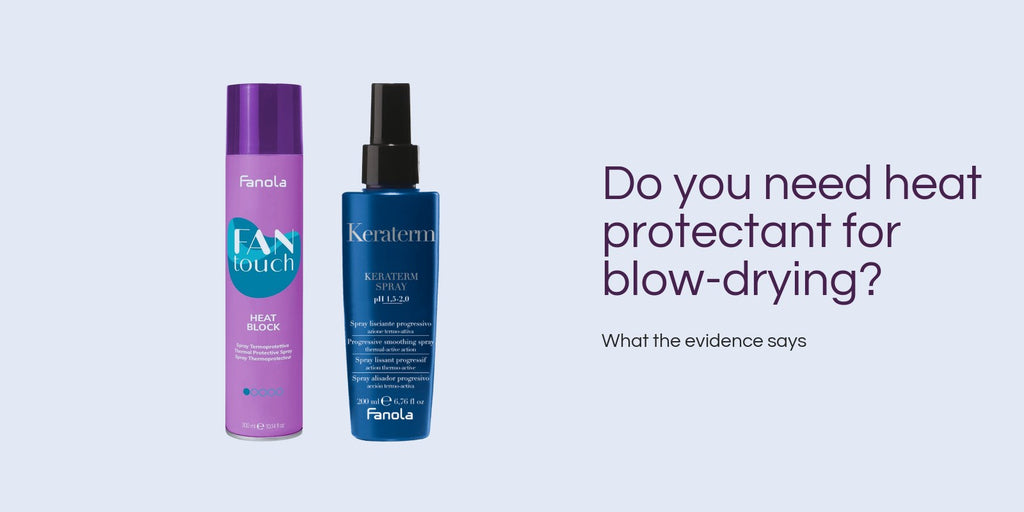
Do You Need Heat Protectant for Blow-Drying?
Our view: heat protectant before blow-drying is optional, not proven. We found no study comparing a finished spray with using nothing at dryer heat. Distance has the best data: in one study, cuticles cracked at every distance, worst at 5 cm, where air near the hair hit 95°C. Dry from about 15 cm on medium heat; fully dry before straighteners.
Heat protectant and blow-drying at a glance
| Question | What the evidence says | Type of source |
|---|---|---|
| Is heat protectant proven for blow-drying? | Not established. We found no published study comparing a finished product with using nothing at dryer temperatures. | Absence across the studies we reviewed |
| How hot does it get near the hair? | 47°C at 15 cm, 61°C at 10 cm, 95°C at 5 cm, measured 0.5 cm from the hair (one lab dryer) | Lab study (Lee 2011) |
| How hot is the air from the nozzle? | From 57.3–64.8°C on one low-running model up to a peak of 108.1°C on another, across 13 dryers; the settings and distances for these readings aren't stated | Consumer body test (Hong Kong, 2023) |
| Damp or dry hair? | Fanola says damp hair before blow-drying; Wella says dry hair "for best results" | Manufacturer directions |
| Before straighteners or tongs? | Dry the hair completely first, roots included | Lab study (irons) and expert advice |
Do you need heat protectant for blow-drying? The short answer
No published study we found shows it either way. The heat protectant studies we found used flat irons and curling irons; the one blow-drying study tested single ingredients, not finished sprays.
Fanola and Wella both direct use before blow-drying (quoted below). On the other side, Michelle Wong of the Lab Muffin blog says dryers don't make hair "anywhere near as hot" as irons, so "you probably don't need heat protecting products for them". That is her hedged opinion, and on the same page she says distance matters.
Our view: no study we found shows harm or benefit from a finished spray at dryer temperatures, and the one thing with measured data is how close and how hot you dry. In practice: if you use a protectant, follow its directions; either way, dry from about 15 cm on a medium rather than maximum heat setting, keep the dryer moving, and get the hair completely dry before any straightener or tongs. The reasons for each are below.
How hot does a hair dryer actually get, compared with straighteners?
Each figure says where it was measured.
- Air at the nozzle. In 2023 the Hong Kong Consumer Council, a statutory consumer body, tested 13 dryers. Across the 13, outlet air ranged from 57.3–64.8°C on one low-running model to a maximum of 108.1°C; the Council doesn't say which settings or distances these readings used. Two models went over 96°C "at certain operation distances" (the distances aren't given), one of them the 108.1°C model. Its separate drying test, with each model on its highest temperature and airflow, used about 75°C, which it describes as the IEC standard's recommended hair-drying temperature: a test condition, not a safe level. No temperature in these sources can be called safe: the 2011 study below found multiple lengthways cuticle cracks with the air near the hair at 47°C.
- Air just above the hair. In a 2011 lab study, one dryer gave 47°C at 15 cm, 61°C at 10 cm and 95°C at 5 cm. The researchers measured the temperature 0.5 cm from the hair surface.
- Why the hair stays cooler while wet. Lab Muffin explains that "the water evaporating cools down your hair so it doesn't heat up as much". So the risk rises as the hair dries and the dryer comes closer.
Compared with straighteners: Lab Muffin says straighteners and curling irons heat hair to somewhere between 95 and 170°C. Chemist Daniel Eldridge, writing in The Conversation, says hair dryers "don't concentrate heat in the same way" as irons. So at 15 cm a dryer heats hair far less than an iron. At 5 cm, the 95°C reading reaches the bottom of Lab Muffin's iron range. That is a rough comparison, because the two figures were measured differently. The gap between a dryer and an iron is real at 15 cm, not at close range. So does a hair dryer need heat protectant? At 15 cm the heat near the hair is far below Lab Muffin's iron range, and we found no study showing a finished protectant changes the outcome; distance is what has measured data, and heat setting is a precaution.
What blow-drying does to hair: the 2011 study in plain English
Lee and colleagues (Annals of Dermatology, 2011; Yonsei University, with two co-authors from the research lab of Korean company Aekyung Industrial) washed and dried hair tresses 30 times, once a day. There were five groups: untreated, air-dried at 20°C, and three dryer groups. No heat protectant was used. The paper doesn't say how many tresses were in each group; the treated groups were washed and dried daily for a month. In the dryer groups, each tress was dried for at most 60 seconds a session; how that compares with drying a full head has not been measured.
What the terms mean: the cuticle is the hair's outer layer, roughly 6–8 layers of overlapping flat scale cells. The cell membrane complex (CMC) is the lipid-and-protein "glue" that holds the hair's cells together. The cortex is the inner bulk, most of the fibre's mass.
| Group | Temperature (0.5 cm from hair) | What happened to the cuticle |
|---|---|---|
| Dryer, 15 cm, 60 s | 47°C | Multiple lengthways cracks |
| Dryer, 10 cm, 30 s | 61°C | More obvious lifting and cracks |
| Dryer, 5 cm, 15 s | 95°C | "Many cracks, holes, and hazy cuticle borders" |
| Air-dried | 20°C room | No lifting or cracks, but bulging under the cuticle (damage to the cell membrane complex) |
No group showed damage to the cortex, the inner bulk of the hair. Two limits: distance and drying time changed together, so the study can't separate them. And the authors' conclusion describes the 15 cm result as "with continuous motion", but the methods don't say how the dryer was handled, and no group compared moving the dryer with holding it still.
What heat protectants have and haven't been tested for
Blow-drying, single ingredients only. In a 1998 study, J. Gamez-Garcia of ingredient supplier Croda dipped single hairs in water for 10 seconds, then blow-dried them for 10 seconds, for 5 to 100 cycles, with the wet hair surface at 30 to 120°C across the test conditions. This caused cuticle cracks, including in hidden layers underneath. Each crack was no longer than one cuticle scale, but when cracked hairs were combed, large pieces of cuticle broke off. In a 100-person panel, these cracks were much more common in people who blow-dry their hair often (an observation, not proof of cause). The paper also tested ingredients, reporting results without counts per ingredient. Three conditioning agents (polyquaternium-11, cetrimonium chloride and stearalkonium chloride), triglyceride oils, silicone oils, mineral oil and petrolatum did not stop the cracking. Glycerin or propylene glycol at 2% stopped it only until rinsed out. Glycerin is in Wella Thermal Image's ingredient list (fifth), but that does not show the spray stops cracking: the study tested glycerin alone at 2%, its effect washed out, and no finished product was tested. Fanola publishes no full ingredient list for its sprays, so no comparison is possible. A protein-silicone copolymer, made by Croda itself, stopped it even after rinsing. We found no independent repeat of this.
Irons, not dryers. Two studies by staff of polymer supplier ISP tested 1–2% polymer solutions, not shop products. On flat irons at 205°C, three polymers gave 42–58% protection to the hair's protein and 31–52.5% less breakage when combing; plain PVP gave none. The authors sum the protein result up as "about 50%", so roughly half the heat damage to the protein still happened. On curling irons at 132°C and 152°C, three pre-treatments reduced the loss of tryptophan (an amino acid in hair protein that the irons gradually destroyed) by 10–20%. So most of these ingredients reduced, but did not prevent, iron damage in those tests. None of this is blow-dry data.
How they work isn't settled. The idea that protectants lay down an insulating film is not shown by the studies we reviewed. Fanola says Heat Block "forms an invisible shield around the hair"; that is the manufacturer's description. Wella says Thermal Image protects hair "from heat up to 220°C", with no test method given.
Wet or dry hair? How to apply heat protection spray for blow-drying
The manufacturers disagree, and none cites test data for its instruction. None of the four states an amount to use.
| Product | Before blow-drying | Before irons |
|---|---|---|
| Fanola Fantouch Heat Block | Damp hair (Fanola) | Dry hair, before the plate |
| Fanola Fantouch Thermo Fix | "Spray on damp hair for blow-drying" | "on dry hair before using tongs or straighteners" |
| Fanola Keraterm Spray | "On towel-dry hair, spray all over and blow-dry with a brush" | Dry hair, one lock at a time |
| Wella EIMI Thermal Image | Dry hair, then "follow with your blow-dryer or other hot tools" | "section by section at arm's length onto dry hair" |
On damp hair, Wella's FAQ says: "For best results, use EIMI Thermal Image on dry hair as directed." That is a recommendation, not a ban.
You may read that water-based sprays are worse. That comes from a 2011 study (University of Manchester with PZ Cussons) on straighteners: hair treated with water, and hair treated with a water-based spray, showed more structural damage under the microscope, and the water-based spray also did worse in stretch tests. The authors' likely explanation is the water evaporating rapidly. Chemical damage (tryptophan loss) was the same with the water-based and alcohol-based sprays. It wasn't tested with dryers, so it tells you nothing about sprays used before blow-drying, where the hair is wet anyway.
The step that matters most: finish blow-drying until the hair is completely dry, roots included, before any straightener or tongs. Hot tools on damp hair is the worst case in everything we reviewed. The reason: Lab Muffin explains that above about 90°C the water inside wet hair can evaporate faster than it can escape, and she puts hair under straighteners and curling irons at 95–170°C. Water inside the hair turning to vapour is also the mechanism a 2025 case report gives for bubble hair (see the technique section). Lab Muffin calls using a straightener on wet hair one of the most damaging things you can do.
Blow-dry technique: what has data and what is advice
- Distance (measured). About 15 cm (6 inches) gave the lowest temperature in the 2011 study, though even that group showed some cracking, and drying time changed with distance. See how far to hold a hair dryer for the full figures.
- Heat setting (a precaution). Use medium rather than maximum heat. This wasn't tested, but outlet air varied from about 57°C to 108°C between dryers, so a hotter dryer at 15 cm will likely heat hair more than the lab dryer did.
- Keep it moving (expert advice). Eldridge and Lab Muffin both recommend it to avoid hot spots; no study compared it with holding still.
- Nozzles, diffusers, cool shot, ceramic or tourmaline. We found no evidence either way.
Bubble hair (air pockets inside the hair) is rare. A 2025 case report says the more than a dozen earlier cases all appear linked to "prolonged exposure of wet hair to high temperatures from blow dryers or other hair styling devices". If your hair suddenly starts snapping or looks bubbly, see a GP or dermatologist. The hair shaft is not living tissue, and no source we found describes it repairing itself, so prevention is what counts.
Blow-drying vs air-drying: which is worse?
It's a trade-off. In the 2011 study, dryers caused more surface damage; only air-dried hair showed bulging under the cuticle. The authors concluded that a dryer at 15 cm "with continuous motion" does less damage overall, weighing two different kinds of damage. Critics disagree: Lab Muffin says the result "hasn't been replicated as far as I know", and the Science-y Hair Blog says the authors didn't make "a solid case against air-drying". Lab Muffin suspects something unusual about that sample, such as sun exposure; the Science-y Hair Blog notes the bulging may have come from a single hair sample, and that air-drying took about two hours each time. In practice: if you blow-dry, the lower-damage setup in that study was the 15 cm group.
Colour-treated, blonde and grey hair
All the blow-dry studies above used untreated hair. There is no dryer data for bleached or lightened hair, so treat lower heat and more distance as the minimum. In one lab study, virgin hair (never coloured or chemically treated) under a hand dryer at about 60°C for 60 minutes in total changed colour by an amount "near the error limit", but part of the medulla (the hair's central core) was lost, so the inside of the hair changed even where the colour barely did. How many home blow-dries add up to 60 minutes has not been measured. In the 2011 study, hair in every treated group, including the 15 cm dryer group, was lighter after 30 washes and dries; the change came soonest, after about 10 treatments, in the 95°C and air-dried groups. Oven heat (about 81°C held for 170 hours, roughly a week non-stop) and curling irons (130–164°C) have yellowed grey, white and bleached hair in lab tests; at about 50°C the oven results were small and mixed. We found no yellowing data for blow-drying. Fanola says Thermo Fix's "heat protection factor" protects the hair and cosmetic pigments from heat; it publishes no test data for that.
Questions people ask
Do I need heat protectant if I blow-dry on cool or low?
Unknown: we found no study that tested protectant, or damage, at low or cool settings. One study found multiple lengthways cuticle cracks at 47°C from 15 cm after 30 daily dries (it tested a distance, not a low setting); another, industry-run lab study tentatively found no extra cracks below 50°C over 20 cycles. Both studies found more damage at higher temperatures than at lower ones, so lower heat and more distance are the safer bet.
Should heat protectant go on wet or dry hair?
Follow the product. Fanola says damp hair before blow-drying; Wella says dry hair "for best results". No test compares the two for blow-drying. Before straighteners, all these brands say dry hair.
What temperature is a hair dryer?
Across 13 dryers tested in 2023, air at the nozzle ran from 57.3–64.8°C on one low-running model up to a peak of 108.1°C on another; the testers don't say which settings or distances these readings used. In one lab study, the temperature 0.5 cm from the hair was 47°C at 15 cm and 95°C at 5 cm.
Does a "protects up to 220°C" rating matter for a hair dryer?
Wella rates Thermal Image to 220°C and recommends it before blow-drying, but gives no test method. No source we found shows what that rating means at dryer temperatures. So a higher number on the can is not evidence of more protection under a dryer, and there is nothing to compare it with: Fanola gives no °C figure for Heat Block, Thermo Fix or Keraterm.
Can I use hair oil as a heat protectant?
In the one study that tested oils under blow-drying, triglyceride oils, silicone oils and mineral oil did not prevent cuticle cracking. That was one industry lab study, not a test of finished products. FarmaVita's Argan Sublime Elixir, for example, is sold for frizz and shine before and after blow-drying; FarmaVita makes no heat-protection claim for it. In practice: use an oil for what it's sold for, and don't count on it as heat protection.
Do I need to reapply before straightening after blow-drying?
First make sure the hair is completely dry, roots included. Fanola's directions say damp hair before blow-drying and dry hair before tongs or straighteners, so following its label means a second application; Wella's directions are for dry hair before any heat tool. We found no study testing whether a second application adds anything.
Is air-drying better than blow-drying?
Neither clearly wins. One study found more surface damage with a dryer and internal bulging only with air-drying; critics say that result hasn't been replicated.


